
What Happened After the Ethics Complaints Against Greensboro Mayor Abuzuaiter; City Attorney Lora Cubbage's Handling Draws New Scrutiny
Abuzuaiter, Cubbage, and the Ethics Investigation That Has Yet to be Initiated; Lora Cubbage Ruled on Complaints That Included Lora Cubbage

On Monday, May 11, 2026, George Hartzman filed an ethics complaint against Greensboro Mayor Marikay Abuzuaiter. One week later, on May 18, Reverend C.J. Brinson filed a separate complaint raising many of the same concerns.

The complaints alleged that Mayor Abuzuaiter repeatedly participated in deliberations and votes involving funding for the Greensboro Sports Foundation (GSF) while simultaneously serving on the organization’s board of directors. They further alleged conflicts involving tourism funding, nonprofit appropriations, occupancy-tax-supported programs, contractor-funded hospitality, and the City’s application of conflict-of-interest standards.
The complaints also highlighted a December 2025 taxpayer funded catered cocktail party involving Mayor Marikay Abuzuaiter, City officials who oversee GSF’s contract, tourism officials, Coliseum leadership, and Greensboro Sports Foundation board members.
Also included was information about a January 2026 dinner hosted by Greensboro Sports Foundation leadership and consultants from Hunden Partners that was attended by City officials involved in appropriations, financing, contracting, and policy decisions related to tourism and Coliseum projects. Questions were raised regarding whether the event implicated North Carolina’s restrictions on illegal gifts from government contractors.
The matter expanded beyond the Mayor when City Attorney Lora Cubbage became involved in reviewing the complaints over objections that she not be involved in the process.
The complaints challenged not only the Mayor’s conduct, but also prior legal advice from the City Attorney’s office concerning nonprofit-board recusals and conflict-of-interest standards. Questions were subsequently raised regarding whether an independent review should have been conducted.
What happened next would shift the focus from the underlying allegations to the City’s handling of the complaints themselves.
On May 18, 2026, George Hartzman met with Greensboro City Councilmembers Crystal Black, April Parker and City Attorney Lora Cubbage in person.
The next day, Cubbage replied to legal objections Hartzman raised after the meeting;
…You believe that legally, Mayor Abuzuaiter should recuse herself from voting on matters such as the budgets of other agencies based on who those agencies may or may not provide some type of funding to. I disagree with that viewpoint from a legal lens. ...Mayor has to recuse herself on voting on matters between the City and the Greensboro Sports Foundation and she does that.
And;
This current ethics complaint can be reviewed by the City Attorney first to be determined if there is a question that needs to be addressed or not. In this current case, we have already addressed your concern...
I replied;
“You are saying you’re not going to follow the Ethics Code, which is a violation of the Ethics Code.
...The current complaints materially differ from the issues previously analyzed, includes factual allegations never investigated, and states broader ethics/impropriety claims
...The present complaints raise substantially broader issues, including;
Greensboro Charter §4.131 indirect financial-interest concerns;
Policy B-22 appearance-of-conflict standards;
the revised Ethics Code’s “reasonable person” impropriety standard;
appearance-of-impropriety issues under the revised Ethics Code;
§133-32 gift and hospitality concerns;
invitation-only contractor hospitality events;
occupancy-tax-funded tourism-development appropriations;
tourism-development coordination,
Hunden consultant-access dinners;
VIP hospitality;
indirect benefits through nonprofit governance,
City of Greensboro contractor-funded entertainment,
whether officials involved in administering contracts accepted “things of value”;
overlapping board service,
refusal to disclose ledgers,
lack of records transparency,
opaque spending structures,
excess benefit transactions,
compensation spikes,
the appearance of self dealing,
lobbying,
failure-to-supervise concerns involving administrative and legal personnel;
whether City legal and administrative personnel knowingly facilitated votes after objections and recusal demands,
inconsistency arguments,
nonprofit fiduciary duties,
appearance-of-selective-enforcement concerns,
transparency and public-records concerns;
the independence of the investigative process itself,
procedural fairness concerns,
and whether hospitality constituted unlawful favors.
You are effectively attempting to convert a compromised prior legal opinion into a complete factual and ethics disposition of the current complaints...”

Cubbage responded at 3:33pm;
I have informally informed you that even if your allegations are true, the Mayor in my legal opinion has not violated the law. She does not sit on the board of Greensboro/Guilford County Tourism Development Authority. Nor was the vote a vote to give funding directly to the Greensboro Sports Foundation. …Mayor did not vote on a specific appropriation to the GSF… Thus, in my legal opinion there is no violation.
On May 21, after incorrectly identifying Guilford County Commissioner Frankie Jones as a member of the Convention and Visitors board, Cubbage informed us “I am also sending to the Attorney General for review”;
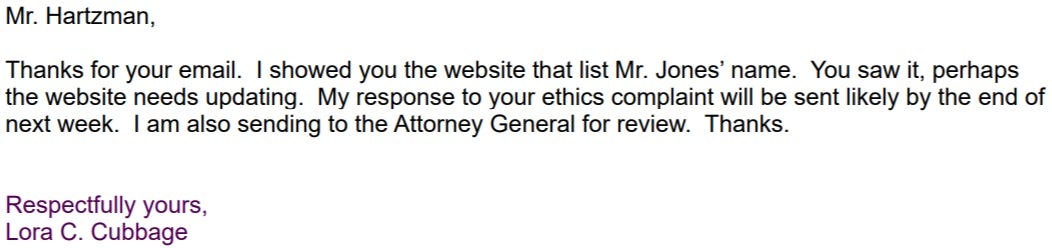
On May 27, Cubbage delivered the determination;
The email included the following contradiction;
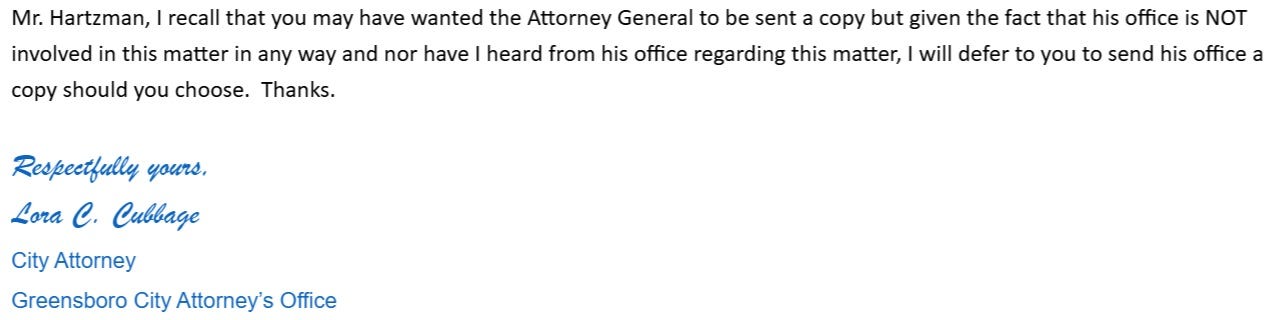
Cubbage initially stated that the complaint was being sent to the Attorney General for review. Later, she stated that the Attorney General's Office was not going to be involved in the matter in any way from her end after saying the opposite.
My response to the determination included;
The Cubbage letter attached reinforces the precise concern raised in the complaints; the City Attorney’s Office, whose own advice, interpretations, prior handling of ethics matters and selection of outside counsel were themselves challenged, ultimately investigated, defended, interpreted and cleared itself.
…In effect, the City reviewed and cleared itself.
…I was informed that the matters would include an Attorney General review. Instead, the City ultimately chose to retain the matters internally and issue a comprehensive defense memorandum clearing the conduct at issue. That reversal only deepens the concerns surrounding the process.
On May 28, I wrote to Mayor Pro Tempore Turner Roth who received the determination, which included;
While the City Attorney correctly notes the complaints were properly submitted, her legal analysis is fatally flawed, her application of case law is inapposite and she failed to address critical allegations altogether.
the City Attorney’s response is legally erroneous, procedurally deficient and fails to follow the mandatory requirements of the Ethics Code.
The citizens of Greensboro deserve a government that follows both the letter and the spirit of the law and its own ethics rules, not one that invents legal loopholes to avoid accountability.
The City Attorney Misapplied N.C.G.S. §133‑32; A Fatal Legal Error
Cubbage failed to adequately supervise and investigate the very factual issues necessary to determine whether ethics or gift policy violations occurred.
The Cited Case Law Does Not Apply to the Facts
The City Attorney failed to cite a single North Carolina case permitting a mayor to vote on public funding for a nonprofit on whose board she sits, because no such case exists.
The problem is compounded by the City Attorney’s own relationship to the current complaints.
the City Attorney kept the review in-house, defended the prior memorandum, defended the selection of outside counsel, defended her own office’s process, and issued the final determination herself.
That is not a code-compliant ethics process. It is institutional self-defense.
The City Attorney’s Determination Ignores Charter §4.131 and Policy B‑22
The Response Did Not Address the Failure-to-Supervise Allegation.
On June 1, I made an inquiry concerning unfilled records requests;
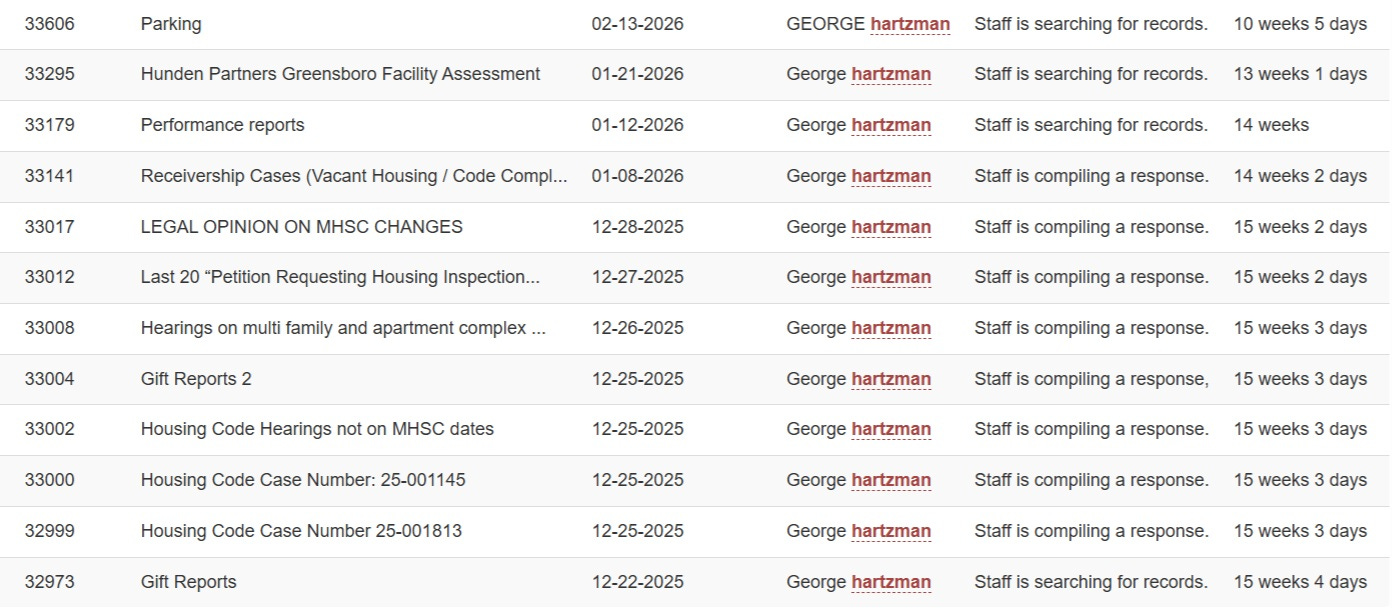
The prolonged delay in producing records related to Hunden Partners, gift reports, legal opinions, hospitality, and other matters that are simultaneously the subject of ethics complaints creates the appearance that information is being withheld from public scrutiny as decisions were made.
At the time the COA determination was issued, multiple public-records requests concerning Hunden Partners, gift reports, hospitality, legal opinions, and related matters remained unresolved. The City Attorney nevertheless concluded that no ethics violation occurred, including by herself and the City Manager etc...
Was the determination made without reviewing the underlying records, or after reviewing records that have still not been disclosed to the complainants, like the Duncan ‘memo’ was withheld until Lora mistakenly thought it was a good idea?
On June 2nd, 2026, the following occurred at Greensboro’s City Council meeting;
Abuzuaiter voted on the item in error. The City Attorney gave the wrong advice.
On June 4, I received the Hunden records request. On June 5, I wrote to Mayor Pro Tempore Turner Roth and the rest of City Council;
At the time the determination was issued, public records requests for the Hunden Facility Assessment and Gift Reports had been outstanding for months.
The Gift Reports are still outstanding.
All facts necessary to evaluate the complaints were not available when the determination was made by the City Attorney.Additional review is warranted before Council treats the matter as closed.
And;
Do you agree with the City Attorney's conclusion that the complaints did not warrant referral to an outside investigator? If so, what facts support that conclusion?
Even if the Ethics Policy gave the City Attorney discretion to make the initial determination, do you believe it was appropriate for the City Attorney to exercise that discretion when the complaints challenged her prior legal advice, her handling of recusal issues, and matters in which her office was directly involved?
And;
The Hunden records did not reveal an independent consultant operating at arm's length from City officials and stakeholders. Instead, the records show a coordinated process involving the Greensboro Sports Foundation, City management, Coliseum leadership, tourism officials, business leaders, and the consultant before major facility recommendations were presented to the public.
And;
The records further show that Greensboro Sports Foundation President Richard Beard described the purpose of the study as creating a framework for future discussions with City Council and the City Manager’s Office regarding facility investments and long-term planning.
Richard Beard’s emails stated his goal was;
“to have this deep study give us a framework on moving forward with a plan to fix up our facilities”
and
“a document that helps us discuss with City Council and CMO about the ‘big picture.’”
Long before many of these issues reached the public through City Council agendas.
And;
The Greensboro Sports Foundation approved a $130,000 contract with Hunden Partners for a sports-facility assessment. The Foundation then organized a January 2026 stakeholder process that included a private dinner at Grandover Resort attended by City Manager Trey Davis, Assistant City Manager Larry Davis, CVB President Tony Cordo, Greensboro Chamber President Brent Christensen, Community Foundation President Walker Sanders, Coliseum General Manager Scott Johnson, and Greensboro Sports Foundation leadership. Mayor Marikay Abuzuaiter was excluded.
The records show that City Manager Trey Davis specifically requested that Assistant City Manager Larry Davis be added to the dinner invitation list.The resulting work contemplated future sports facilities and public investment.
And;
The dinner, "hosted by the Greensboro Sports Foundation" was held at Finial Restaurant at Grandover Resort.
Kelly Harrill participated in the Hunden process.
Kelly Harrill is/was chairman of the Greensboro/Guilford County Tourism Development Authority.
Kelly Harrill is Executive Vice President of Hospitality for Koury Corporation, which operates Grandover Resort, the Sheraton Greensboro, and the Holiday Inn Coliseum.
Kelly Harrill is on the GSF board.
The consultants were housed at Grandover.
And;
The expense was funded directly or indirectly through public money while GSF was simultaneously seeking renewal of its City contract from Trey and Larry while promoting facility recommendations arising from the Hunden process.
If Greensboro Sports Foundation paid for the January 13 dinner and was operating under a City contract at the time, the attendance of City Manager Trey Davis and Assistant City Manager Larry Davis raises legitimate questions under N.C.G.S. § 133-32 concerning gifts or favors from a government contractor.
On June 6, I wrote;
How did Lora know the evidence was insufficient if she hadn't seen the records?
How did she know there weren't relevant gifts, hospitality, relationship, communication, or involvement if the records documenting those subjects were still being withheld?
Did she not realize there were relevant unfilled records requests?
The City Attorney made definitive conclusions regarding issues that were the subject of pending public records requests.
And;
The determination repeatedly relies on the distinction between a vote directly funding GSF, and a vote on the overall budget of another entity that later funds GSF.
But the Hunden records raise a somewhat different question; Was GSF actively involved in developing, promoting, coordinating, and advancing projects that later came before City Council?
Would a reasonable person question impartiality when a public official participates in governmental decisions involving projects that an organization she helps govern was actively promoting, studying, developing, or advocating?
Was Marikay participating as an independent public official, or as a governing member of an organization that helped advance the projects?
After reviewing the documents and communications, I found Greensboro City Attorney Lora Cubbage improperly interpreted North Carolina's nonprofit conflict-of-interest statute, N.C.G.S. § 14-234.3, when dismissing the ethics complaints.
The central argument is that Cubbage relied on a "pass-through defense"; the theory that appropriations to the CVB, TDA, Coliseum, or other intermediary entities are legally distinct from funding GSF, even when those entities routinely transfer substantial funds to GSF.
Cubbage’s determination;
Added the word “directly” to a statute even though it does not appear.
Relied on personal-benefit concepts associated with older conflict statutes which don’t apply.
Selectively quoted a 1999 Attorney General opinion while omitting language about the “entire process.”
Failed to analyze whether budget votes constitute an “appropriation.”
Failed to examine the recurring funding relationship between CVB, Coliseum entities, and GSF.
Failed to analyze what the Mayor knew about those funding flows.
Failed to address whether appropriations intended to reach GSF trigger the statute.
The AG said the relevant conflict could be the entire grant process, not merely the final grant.
"the conflict transaction is the entire Partners Program grant process, and not just the grant to the nonprofit corporation", and "this conflict encompasses the entire process of awarding CHIP grants"
As a City Council member, Abuzuaiter voted for;
FY2022 records identifying contributions of $150,000 from the Greensboro Area Convention and Visitors Bureau and $150,000 from the Greensboro Coliseum Complex.
FY2023’s GSF 990 shows contributions of $200,000 from the Greensboro Area Convention and Visitors Bureau, $85,000 from the City of Greensboro, and $180,000 from the Greensboro Coliseum Complex.
FY2024 Schedule B reporting contributions of $200,000 from the Greensboro Area Convention and Visitors Bureau, $89,800 from the City of Greensboro, and $185,000 from the Greensboro Coliseum Complex.
If public officials know that appropriated funds will predictably and repeatedly flow through intermediary entities to a nonprofit on whose board they serve, does § 14-234.3 require recusal?
YES
City Council should refer the complaints to an independent investigator and to require the City Attorney to identify legal authority supporting the pass-through theory or acknowledge that the issue was incorrectly fully analyzed via an omission of material information.
Related;


This article is an opinion and analysis piece based upon publicly available records, government documents, nonprofit filings, public meeting records, correspondence obtained through public records requests, and legal authorities cited herein.
The article raises questions concerning the interpretation and application of North Carolina law, including N.C.G.S. § 14-234.3, and discusses matters of public concern involving elected officials, public employees, and nonprofit organizations. Any legal analysis presented reflects the author’s interpretation of the available facts and authorities and should not be construed as a definitive statement of law.
The author does not assert that any individual has committed a crime, violated the law, or engaged in unethical conduct. Rather, the article examines whether certain actions, decisions, funding arrangements, and legal interpretations warrant further review, explanation, or independent investigation.
Readers are encouraged to review the cited statutes, opinions, public records, and source materials and to reach their own conclusions. Any person or entity discussed in this article is presumed to have acted lawfully unless and until a competent authority determines otherwise.