
Formal Objection & Demand for Recusal of Mayor Marikay Abuzuaiter and Councilman Hugh Holston from Agenda Items H.18 & H.19 on Tuesday, January 20, 2026
OFFICIAL SUBMISSION TO THE GREENSBORO CITY COUNCIL FOR INCLUSION IN MATERIALS TO THE LOCAL GOVERNMENT COMMISSION

RE; Objection to Agenda Items;
H.18; 2026-53 Public Hearing and Resolution Making Certain Findings and Determinations Regarding the Proposed Financing of Various Improvements to the City’s Coliseum Complex
H.19; 2026-56 Ordinance in the Amount of $20,310,000 Amending the FY 2025-2026 Budget for Hotel/Motel Occupancy Tax Fund and Amending the Coliseum Bond Fund Budget
Grounds; Pervasive & Unaddressed Conflicts of Interest Violating N.C.G.S. § 14-234.3 and § 133-32, the City’s Code of Ethics and Charter
To the Greensboro City Council and the North Carolina Local Government Commission,
This constitutes a formal objection and demand for the immediate recusal of Mayor Marikay Abuzuaiter, Councilman Hugh Holston and City Managers Trey Davis and Larry Davis from all discussion, deliberation, actions and voting on Agenda Items H.18 (2026-53) and H.19 (2026-56), pertaining to financing for Coliseum Complex improvements.
This demand is based on documented violations of North Carolina conflict-of-interest law, specifically Mayor Abuzuaiter’s violation of N.C. General Statute § 14-234.3; “Local public officials participating in contracts benefiting nonprofits with which associated.” which states No public official shall knowingly participate in making or administering a contract, including the award of money in the form of a grant, loan, or other appropriation, with any nonprofit with which that public official is associated. The public official shall record his or her recusal with the clerk to the board, and once recorded, the political subdivision of this State may enter into or administer the contract.”
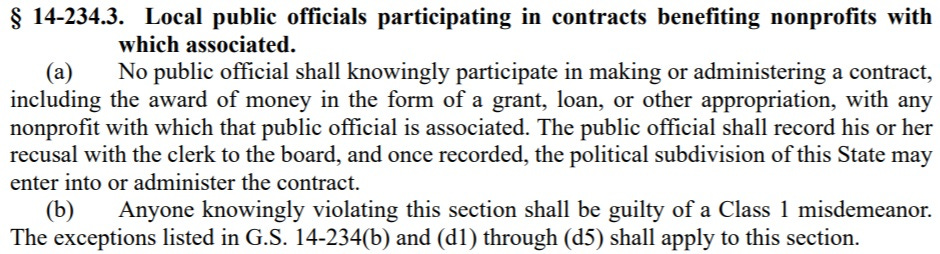
Mayor Marikay Abuzuaiter is listed as a board member on the Greensboro Sports Foundation (GSF) board alongside GSF CEO Richard Beard and Scott Johnson, who’s the coliseum complex general manager.
Mayor Abuzuaiter has a longstanding practice of making financial decisions that benefit an organization she was legally obligated to recuse herself from;
2023; GSF Government grants; 304,800; Marikay voted for the appropriations.
2024; GSF Government grants; 445,000; Marikay voted for the appropriations.
This is not a discretionary ethical guideline but a legal requirement.
A review of the financial structure, combined with documented patterns of governance, reveals a process compromised by prohibited conflicts of interest and a circular, self-dealing use of public funds that fails to meet the statutory standard of being “necessary and prudent.”
Necessary; The debt must be for a lawful public purpose, and the amount must be justified. The need should be clear and not manufactured.
Prudent; The financing must be structurally sound, cost-effective and undertaken through a fair, transparent and lawful process. It must protect the city’s long-term financial health.
It is not ‘necessary’ because the demonstrated need is entangled with a circular use of public funds to create artificial demand. It is not ‘prudent’ because the financing structure is compromised by prohibited conflicts of interest and an avoidance of public scrutiny, posing a clear risk to the city’s fiscal integrity and governance.
The LGC cannot find this debt ‘prudent’ when the process behind it has been demonstrated to be unlawful and the financial structure rewards the very taxpayer funded advocates who promoted it.
On January 8, 2026, Triad Business Journal Reported;
Greensboro leaders say coliseum complex needs $100M renovation
Greensboro plans $22 million renovations for First Horizon Coliseum.
Scott Johnson ...said the city of Greensboro is planning a $22 million upgrade of the coliseum and special events center.
Richard Beard, president and CEO of the Greensboro Sports Foundation, said Greensboro is providing the $22 million for the renovations through a bond, all of which will be paid back through hospitality and hotel taxes.
Beard said the repairs will include renovations of restrooms and other areas on the lower concourse, which he described as “an embarrassment” at some big events because they are outdated. Lighting and sound will also be improved inside the arena. The lobby of the special events center will be updated and a new premium club will be built, he said. ...Beard said the rest of the venues in the coliseum complex need enhancement, including the Greensboro Aquatic Center and the Novant Health Fieldhouse where the Greensboro Swarm play.
“We’re talking about an excess of $100 million of improvements needed at the Coliseum Complex, but we don’t have that kind of money, so we’re chipping away in other ways,” Beard said.
Johnson said the Oak View Group, which manages the coliseum, will be seeking additional funding from the North Carolina state legislature.
The $21M bond is a “chipping away” first step. Approving it commits the city to a long-term financial path for a project 5x larger, making scrutiny of the initial decision and its advocates even more critical.
Scott Johnson confirms they will “seek additional funding from the NC state legislature”. This proves the project relies on continuous public subsidy, managed by the same conflicted network (GSF and Coliseum management etc.).
Richard Beard’s admission that facilities are outdated raises the question; why were these maintenance needs not addressed through standard capital budgeting, rather than a rushed, conflicted bond process?
The article confirms it’s a bond repaid by hotel taxes, which also funds the GSF. This type of “revenue bond” or “limited obligation bond” does not require a public vote, which is exactly why conflicted officials may favor it over a General Obligation Bond.
Neither agenda item mentions over $100 million in needed work
The council is not voting on a one-time fix. Beard and Johnson, who also serve on the Greensboro Sports Council with GSF board members Brett Schulman and Donald Moore, admit this is a $22 million down payment on over $100 million in needed work, with plans to immediately lobby the state for more.
An email invitation sent by GSF President Richard Beard on December 22, 2025, cast a glaring spotlight on the organization’s spending habits and the ethical lines that bind public officials;
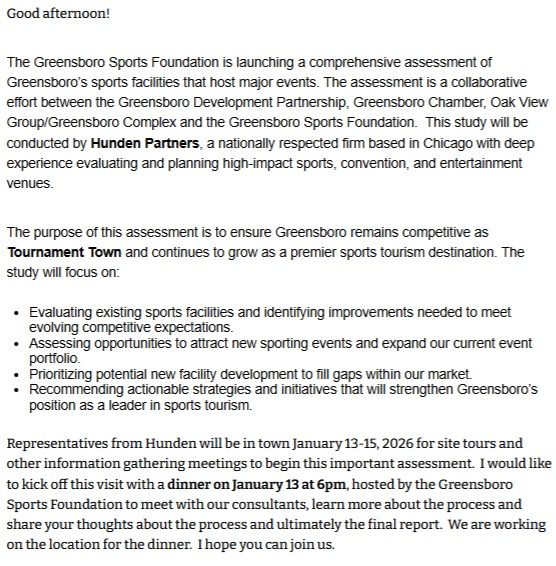
The invitation, to a dinner for consultants, the GSF board and city officials including City Manager Trey Davis who asked to include Assistant City Manager Larry Davis, raises critical questions about whether taxpayer-derived funds are being used for prohibited lobbying, and whether city officials broke laws by confirming attendance.
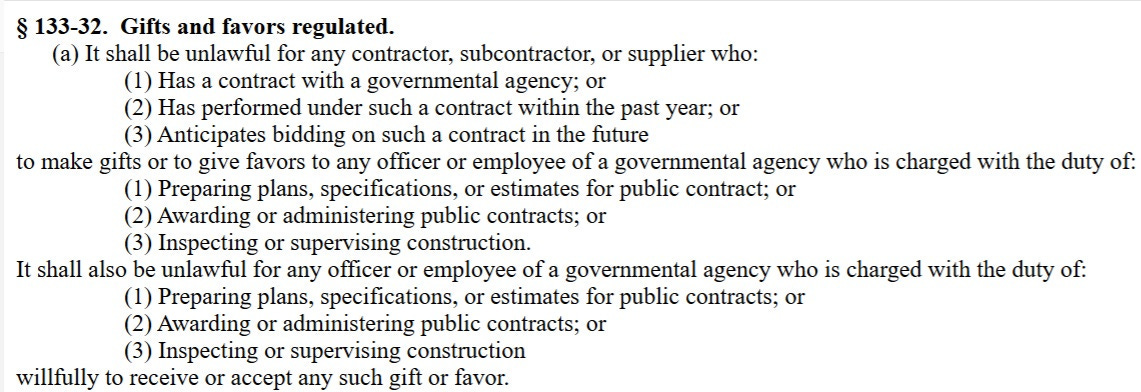
The issue centers on a North Carolina statute, N.C. General Statute 133-32, which is designed to prevent favoritism in public contracting at the local level.
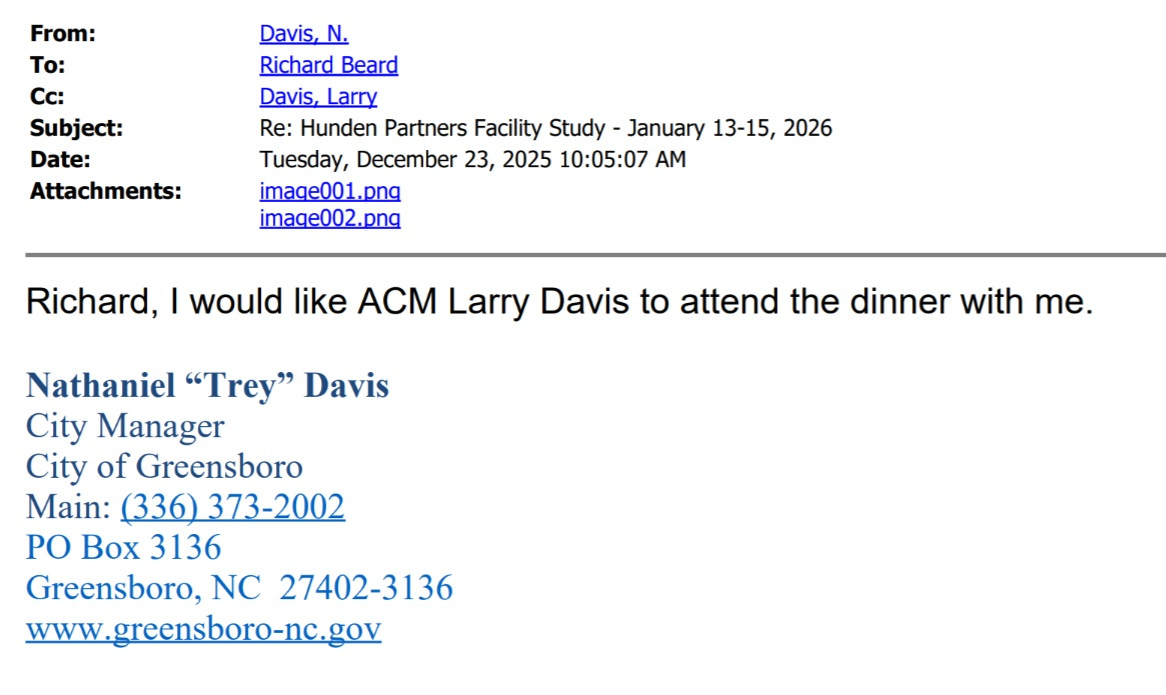
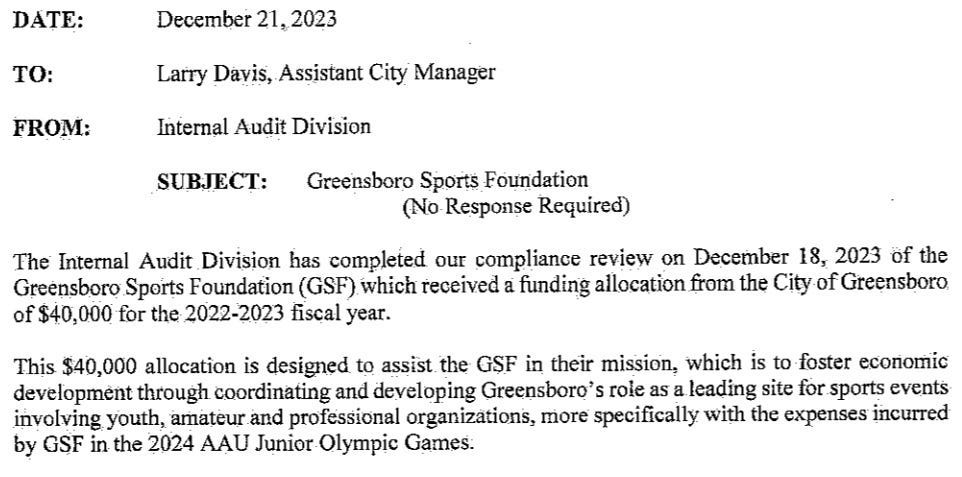
Larry Davis, Assistant City Manager; His current responsibilities directly oversee GSF’s funding streams and contractual compliance, administers the financial systems that process payments to GSF and supervises the Internal Audit department, the office that is supposed to investigate any irregularities or compliance issues with city contracts, which didn’t happen with the entirety of GSF’s $304,800 2023 taxpayer allocations, which Abuzuaiter and Holston voted for. Greensboro’s Internal Audit department only signed off on $40,000 of GSF spending in it’s annual reviews, even though the foundation received by far more taxpayer monies, as Larry Davis must have been aware of;
Under North Carolina law (NCGS § 133-32), it is unlawful for contractors, which includes the GSF, to give gifts or favors to public officials involved in awarding or administering public contracts, which includes Trey and Larry. It was also illegal for Davis and Davis to accept such gifts, as the actions may constitute quid pro quo arrangements or outright bribery under state and federal law.
A Pattern of Questionable Spending
This dinner invitation is not an isolated incident but fits a documented pattern of surging expenditures by the GSF. Beard and Abuzuaiter have declined to provide taxpayer funded expenditure ledgers for the following;
2021; Lobbying $0
2022; Lobbying $0
2023; Lobbying $61,265
2024; Lobbying $02019; Travel $2,917
2021; Travel $21,333
2022; Travel $11,750
2023; Travel $104,302
2024; Travel $9,9332019; HOSPITALITY $0
2022; HOSPITALITY $0
2023; HOSPITALITY $127,357
2024; HOSPITALITY $0
$127k in “hospitality” in one year is huge. If it’s schmoozing Greensboro’s executive and elected officials or board members with public money, that’s exactly the kind of thing that runs afoul of NC G.S. 133-32.
The extent of Mayor Marikay Abuzuaiter and Councilman Hugh Holston’s undisclosed benefits from the Coliseum advocacy network remains a central, unanswered question that invalidates the bond approval process. Holston is listed as a City Council Liaison to the War Memorial Commission (WMC) along with Richard Beard. Holston’s conflict of interest is largely the same as the Zack Matheny/Arthur Samet issue which the American Bar Association’s Standing Committee on Pro Bono and Public Service recently opined on, which states “state law sets minimum ethics/conflict standards; local governments can layer on stricter rules, provided they don’t contradict state law”, which Greensboro’s Code of Ethics and City Charter do;
Chidi Akwari and Marc Isaacson serve on both the WMC and GSF boards. Kelly Harrill serves on the GSF board and the Greensboro Guilford County Tourism Development Authority/Greensboro Area Convention & Visitors Bureau which provides funds to the GSF along with the City of Greensboro and the Coliseum Complex. Both Abuzuaiter and Holston illegally voted to approve all three budget appropriations.
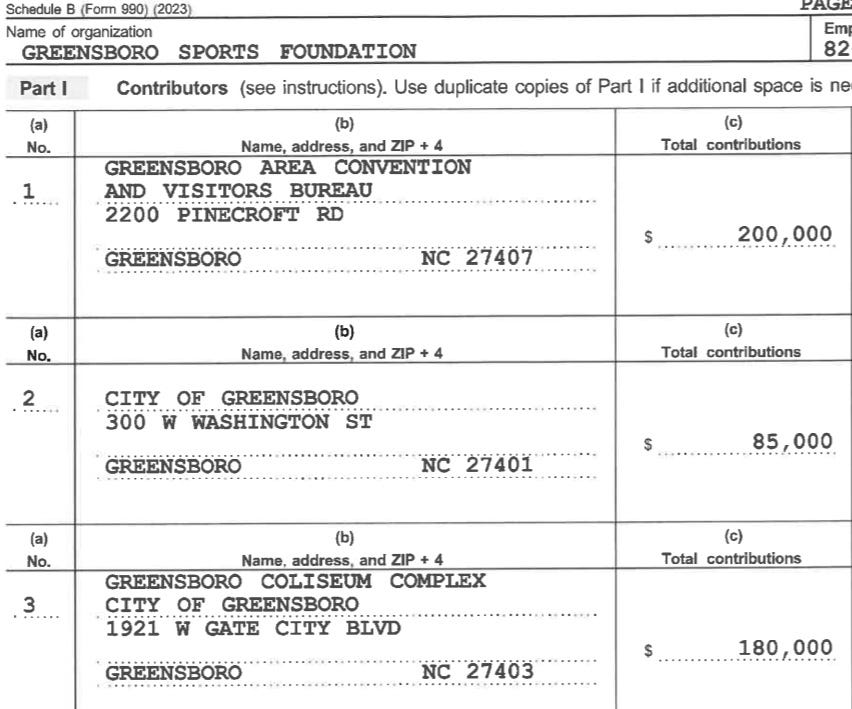
GSF President Richard Beard also recently misled Public Integrity Watch about when the GSF FY 23-24 Tax Return was filed in violation of federal nonprofit transparency law. Could it be that in light of what’s happening to Zack Matheny, Richard didn’t want voters to know the taxpayer funded foundation he runs spent $13,954 on “Sponsorship/Tickets” after spending $3,250 in 22-23, $1,133 in 21-22 and nothing noted for 20-21 when he wasn’t President yet?
To date, neither Beard or Abuzuaiter have disclosed what “Sponsorship/Tickets” the GSF spent $13,954 on. Without detailed disclosure, this could be mischaracterized personal or entertainment spending rather than bona fide program-related charitable expenses. For instance, with Larry Davis, again, along with Assistant City Manager Nasha McCray;

This lack of transparency deprives the public of essential information about how an organization funded with taxpayer dollars manages its finances and operations, especially now as the GSF is actively advocating for $100 million of sports related public spending.
GSF’s website shows 26 directors, of which only one, Marikay Abuzuaiter, is female.
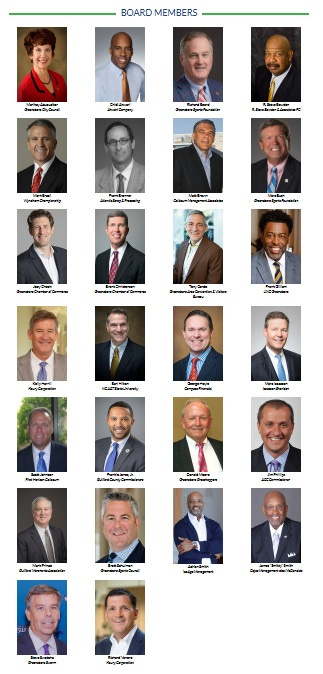
The GSF is governed by a 26-member board that is 96% male, with Abuzuaiter the sole female member and elected official. This lack of demographic and institutional diversity, combined with the Foundation’s substantial spending on travel, hospitality and Sponsorship/Tickets, calls into question the independence and rigor of its oversight, especially considering what the GSF does;

The staggering gender imbalance on the Greensboro Sports Foundation’s board, with only one woman among 26 members, not only highlights a profound failure of inclusion but also undercuts the very mission of promoting youth sports for all. If the goal is to inspire and represent the entire community, including the countless young girls who participate in athletics, this lopsided composition sends a damaging message that leadership and decision making power are fundamentally male domains. This lack of diversity is not just a matter of optics; it risks creating blind spots in programming and outreach, ensuring that the GSF’s vision for sports in Greensboro is shaped without the essential input of half the population it claims to serve.
Beard and Demp Bradford were personally paid 59% of the $445,000 Greensboro and Guilford County’s taxpayers subsidized the GSF with in 23-24.
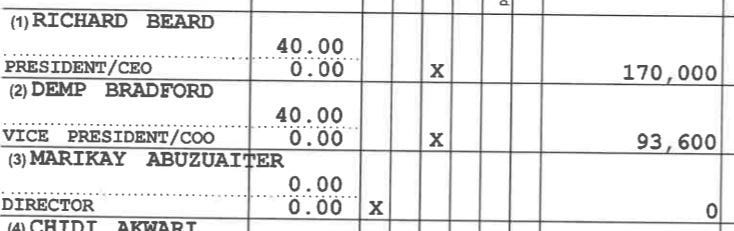
The tax return also says Both Beard and Demp Bradford both work 40 hours a week for the foundation, which is highly unlikely.
Approving this first bond, under a cloud of conflict, commits Greensboro to a long-term financial path for projects managed by the same officials and organizations who violated laws to get here. This is not prudent finance; it is enabling a broken system.
If the dinner or previous events spent taxpayer monies on perks for foundation board members, some GSF’s expenditures potentially constitute violations of N.C. Gen. Stat. § 14-90 (embezzlement of public funds) and violate the IRS Private Benefit Doctrine for 501(c)(6) organizations. Coordinated gifts and board votes indicate a potential 18 U.S.C. § 371 (Conspiracy) charge against GSF board members and Greensboro’s Mayor Marikay Abuzuaiter. This kind of behavior is not new to Greensboro;

The Financing
Total Cost & Source; The bonds, with a principal of $21,000,000 at ~5.39% interest, will cost taxpayers approximately $33.5 million over 20 years, requiring annual debt service of $1,675,000. This service is pledged by a municipal 3% Hotel/Motel Occupancy Tax which also funds the GSF.
Marikay Abuzuaiter appears to have been involved in making the bond happen. From the resolution;
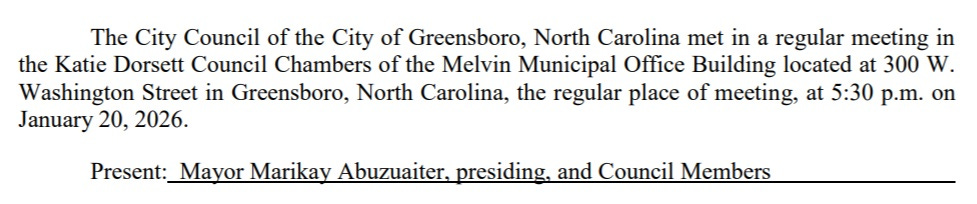
Objection to the finding that this plan is in the “best interest” of the City.
This claim ignores a fundamental structural conflict that invalidates the cost-benefit analysis.
Circular Use of Funds; The financing relies on the 3% Hotel/Motel Occupancy Tax. A portion of this same tax revenue, approximately $200,000 annually, is granted to the GSF via the Convention and Visitors Bureau.
Financial Conflict; The city wants to allow the pledged revenue stream to fund an advocacy organization that lobbies for projects the debt is being issued to fund. Over the 20-year term, roughly $4 million, and probably more of the tax revenue securing this bond will also pass through the GSF. This creates a self-perpetuating cycle where taxpayer money is used to create demand for more taxpayer debt, which cannot be considered in the public’s “best interest.”
Objection to the justifications for why this limited obligation bond is “preferable.”
The reasons provided are either misleading or stem from a process corrupted by conflicts of interest.
Objection to “Insufficient Authority” and “Time Delay”; The claim that a voter-approved general obligation bond would cause an unacceptable delay presumes the public cannot be trusted with a timely decision on about $33.5 million in debt and interest. This circumvention of a public vote is especially troubling given the documented conflicts of interest involving officials who stand to benefit professionally and organizationally from the project’s approval. Avoiding voter scrutiny is not a valid justification when the process lacks integrity.
Objection to “No Assurance Voters Would Approve”; This admission is central to the objection. The legitimate fear that voters would reject this financing, when presented with the full context of circular funding and institutional conflicts, is not a reason to avoid a vote, it is the very reason one is necessary.
Objection to Finding “Reasonably Comparable Costs”;
This finding is based on information provided to a City Council that includes members with disqualifying conflicts of interest, including the Mayor who sits on the board of the advocating GSF. A General Obligation (GO) bond would almost certainly be less expensive than a Limited Obligation bond, adding millions in unnecessary interest cost, directly challenging the resolution’s finding that the coliseum financing plan is “efficient and cost effective.” The city’s own agenda shows a demonstrably cheaper alternative (H.21 approximately 3.76% instead of ~5.39%) for public projects exists. The “current interest rate environment” cannot justify rushing through a fundamentally flawed deal.
Tainted Analysis; Any financial analysis presented to advocate for this bond has been filtered through an advisory process that includes the President of the GSF, Coliseum management and liaised to the Council by two conflicted voting members. Therefore, the “information provided to the City Council” cannot be assumed to be impartial or comprehensive.
Ignored Long-Term Cost; The true cost of this financing is not just the $21 million principal plus ~$12.5 million in interest. The total cost should also include the $4 million in diverted tax revenue that will fund the advocacy for this and future projects, a recurring expense not accounted for in a standard bond comparison.
Pattern of Unchecked Conflicts; The council's failure to address similar conflicts with other members (e.g., Zack Matheny/DGI and LGC board member Nancy Hoffmann) shows a disregard for the law. Both GSF board members Mark Prince and Mark Brazil are also DGI board members, while Adrian Smith, currently on the GSF board, was Chair of DGI before suddenly not so in 2025, creating shared financial interests across the two nonprofits, one of which is currently under SBI investigation.

Abuzuaiter is charged with impartially overseeing the performance and spending of the GSF. Simultaneously, as a GSF board member, she has a fiduciary duty to advance the interests of the foundation. These obligations are in direct conflict with her role as Mayor, which has so far prioritized GSF over Greensboro’s taxpayers. A financing process compromised by officials who are legally prohibited from participating cannot be considered lawful, transparent or in the public interest.
Formal Demands
In light of the above, we demand the following actions be taken for the January 20, 2025, public hearing and all subsequent proceedings;
Immediate Public Recusal; Prior to any discussion, Mayor Abuzuaiter and Councilman Holston must publicly state their recusal from Items H.18 and H.19, citing N.C.G.S. § 14-234.3, Greensboro’s Code of Ethics and City Charter.
Formal Record; Their recusals must be formally and separately recorded in the official meeting minutes.
Complete Non-Participation; They must not participate in any more discussion, ask any more questions or attempt to influence other council members regarding these items, as they have most likely already done.
Notification to Oversight Bodies; This objection and the record of recusal (or lack thereof) must be included in all materials forwarded to the North Carolina Local Government Commission (LGC). A decision tainted by conflicted votes is not “necessary and prudent” and jeopardizes the integrity of the process.
Thanks,
George Hartzman
Public Integrity Watch
Related;


Disclaimer: The analysis and report are based entirely on publicly available documents, including but not limited to: City of Greensboro agendas and resolutions, Local Government Commission (LGC) filings, IRS Form 990 tax returns for the Greensboro Sports Foundation (GSF), archived public meeting minutes, and correspondence obtained through public records requests. The financial calculations presented are derived from the terms and figures disclosed in these official sources.
The purpose of this reporting is to inform the LGC and the public regarding the governance, financial structure and potential conflicts of interest surrounding a significant municipal bond issuance. The conclusions drawn connect documented facts as presented in the public record. Allegations of conflicts of interest are based on the direct application of North Carolina General Statutes to the recorded affiliations, actions and voting histories of public officials.
Every effort has been made to ensure accuracy. All individuals and entities named have a right of reply, and any substantive response will be included if received. This work is conducted in the public interest to promote transparency and accountability in local government finance.