
Suspect; Days Before Greensboro & Guilford County Budget Votes, A JetZero Ribbon Cutting?; Near Term Job Prospects Don't Add Up
Greensboro and Guilford County are preparing to borrow, build, and spend billions based on a future that hasn't arrived, and may not

On June 15, regional leaders will celebrate JetZero with a ribbon cutting at Piedmont Triad International Airport.

The next day, Greensboro’s City Council is expected to vote on its budget with a 21% property tax increase. On the 18th, Guilford County’s Commissioners are supposed to adopt theirs with a 19% property tax increase.
Neither the 21% or 19% tax hikes have been reported to the public by our local press.
Instead we got;
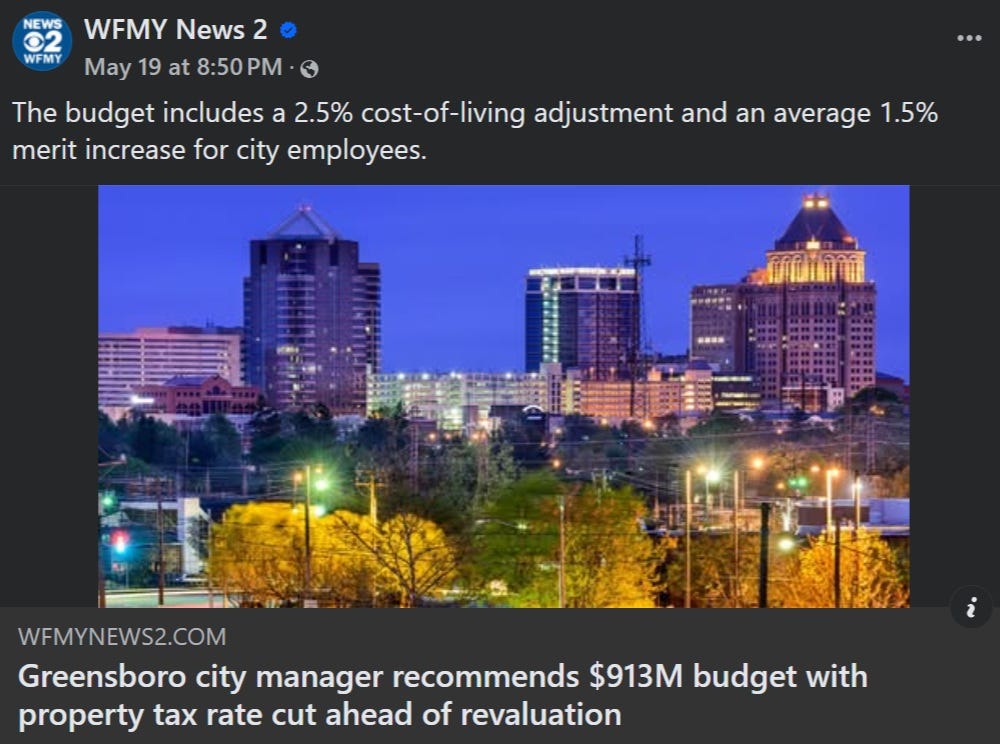
And;
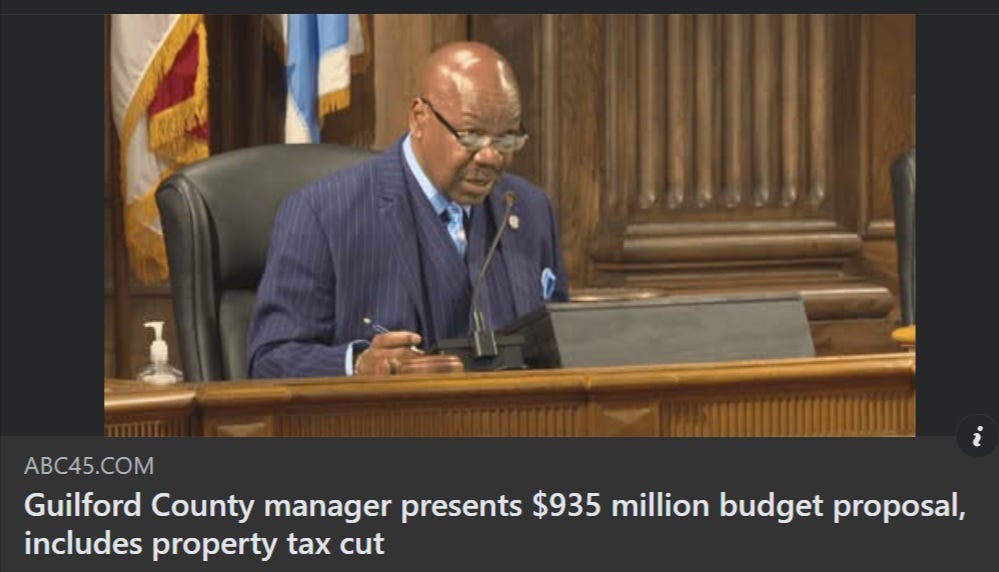
It is difficult to get a man to understand something
when his salary depends on his not understanding it
Upton Sinclair
The timing is difficult to ignore.
Both governments proposed budgets with;
long-term capital expansion,
major infrastructure commitments,
utility increases,
and debt tied to projected future growth.
And now, just before those votes, comes another carefully staged reminder that the Triad’s economic future is supposedly right around the corner.
JetZero may ultimately become a transformational success, Toyota may fully scale and Boom Supersonic may eventually fly passengers.
Greensboro, Guilford County want to borrow, build and soak taxpayers today based on speculative assumptions of tomorrow, with an abysmal track record of failing public promises.
JetZero
Taxpayers are on the hook for up to $2.35 billion in incentives for JetZero, a company founded 5 years ago, which currently employs over 225 people, and hasn’t built a full scale aircraft.
While JetZero’s commitment to the region is significant, the actual timeline for job creation envisions adding jobs gradually through 2037, with the full 14,500 job impact not materializing until 2063;
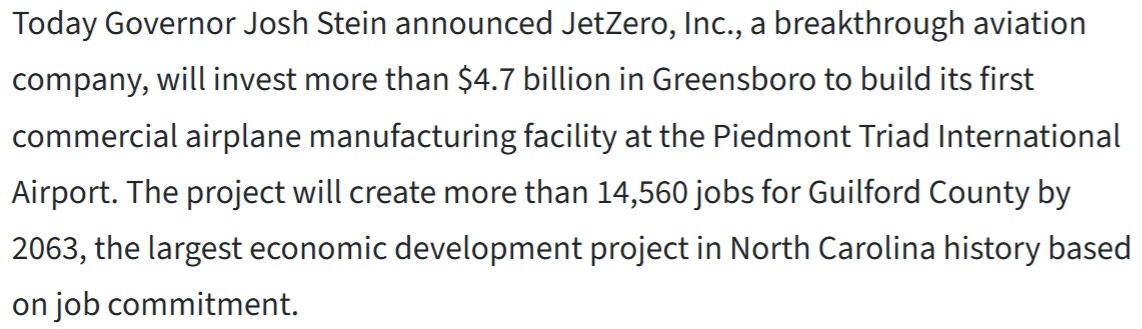
Optimistic projections about JetZero driving near-term job growth in the Triad region without context appears to conflate long-term possibilities with reality. JetZero does not yet have a certified passenger aircraft, and aerospace certification programs of this scale commonly take a decade or more before reaching mature commercial production, assuming they succeed at all.
The suggestion employees are already “beginning to move to the area” based on two executive relocations is hardly evidence of meaningful labor migration.
JetZero currently appears to have roughly 10-12 Greensboro specific job openings publicly listed, mostly highly specialized aerospace and manufacturing roles.
JetZero did not immediately respond for a current local workforce count.
Citing a multi decade timeline as justification for expecting job growth to “pick up” in the near term demonstrates either a fundamental misunderstanding of economic development timelines or a willingness to spin preliminary corporate commitments into imminent job market transformation, neither of which serves the public’s need for accurate information right before budget votes with massive property tax increases.
JetZero’s blended wing body aircraft is a highly speculative commercial concept that departs from proven tube and wing designs and has never successfully reached commercial passenger service. Flying-wing designs are inherently unstable, requiring complex flight control systems that remain unproven for civilian transport. Despite billions in research by NASA, Boeing and others, the only operational examples are military aircraft like the B-2 bomber, where cost and commercial viability are irrelevant.
revolutionary shifts in design not seen in decades — like JetZero’s blended-wing body — can still happen.
JetZero is effectively asking North Carolina to bet on solving aerospace engineering challenges that have stymied the industry for decades, or to accept that the end product may be military rather than commercial.
Guilford County Commissioner Chairman Skip Alston is expecting 27,000 new jobs, pointing out the people filling these positions are expected to move to Guilford County from outside the region, subsequently bringing their families in 3 to 5 years.
3 to 5 years?
Can some promoting erroneous ideas believe self created illusions?
The region’s political messaging revolves around;
explosive incoming growth,
inevitable future prosperity,
and all the borrowing will eventually pay for itself.
Really? Aerospace projects of this scale often require 5-10 years or more to move from development into full commercial certification and production.
We are likely being sold a bridge to nowhere.
As of June 30, 2025, Greensboro was carrying more than $1.014 billion in bonded debt, while Guilford County reported roughly $1.335 billion. Combined reported long-term debt between Greensboro and Guilford County already exceeds roughly $2.43 billion.
Greensboro has a $2.81 billion Capital Improvement Program while Guilford want’s to issue at least another $1.13 billion in school construction debt, justified by projected future prosperity.
Greensboro/Guilford are now tied to well over $4 billion in existing and contemplated obligations before even fully accounting for pensions, retiree healthcare liabilities, and future utility borrowing.
Recent Census estimates showed Greensboro itself grew by only about 2,312 residents in 2025, or roughly 0.6%. Modest growth, especially compared with places like Charlotte and Raleigh.
Yet our leaders are all about multi billion dollar infrastructure buildouts
as though projected growth is guaranteed. Taxpayers are set to fund billions of new debt expanding utilities, building roads, and embedding long-term obligations into future budgets.
From 2020 to 2024, the Burlington MSA grew by 6.7%, Winston-Salem grew by 4.3% and the Greensboro/High Point area grew by 3.1% compared to Wilmington’s 13% growth, Raleigh/Cary 10.2%, Charlotte’s 8.1% and the state’s overall 5.7% growth.
60% of incentive based projects approved between 2002-2013 failed to meet job, wage, or investment obligations. In 2024, there were 20 failed state incentive projects, and in 2023, 19 projects were unsuccessful with 15 failures in 2022. Less than half the promised jobs never appeared. In 2026, North Carolina officials terminated incentive deals tied to companies that were projected to create 1,500 jobs and generate up to $3 billion in economic impact.
Our elected leadership is front loading enormous public infrastructure and financial commitments based on speculative projections that may not materialize.
Boom Supersonic; North Carolina committed more than $100 million in public support tied to Boom’s Greensboro operation. The “superfactory” sits idle nearly two years after completion.
Boom still doesn’t have an engine.
The aircraft remains unfinished.
United Airlines CEO Scott Kirby estimated Boom’s odds of success at “50/50”
Several aerospace analysts openly question the company’s viability.
Yet infrastructure spending already occurred. The obligations already exist.
VinFast; North Carolina committed $450 million. The project was projected to create 7,500 jobs in Chatham County. The State of North Carolina is suing to reclaim the land and infrastructure after the company failed to create the jobs.
Toyota Battery Manufacturing; The facility officially projects 5,100 employees, with about 3,000 at present. It’s not in Guilford County.
Taxpayers are being set up to absorb socialized downside risk for private gain.
Capitalism without financial failure is not capitalism at all
but a kind of socialism for the rich
James Grant
If projects get delayed, automation reduces workforce needs, growth arrives slower than projected, workers commute rather than relocate, or recession hits before full buildout, the debt still exists.
The infrastructure still requires maintenance. The utility systems still require repayment. Taxpayers still pay.
Private companies can restructure, delay, pivot, downsize or fail.
We get stuck with debt service, roads, utilities, schools, parking decks, pension obligations and infrastructure maintenance regardless of whether the projected prosperity fully arrives.
Households are going to get stuck with higher property taxes, water bills, insurance, fees, rent, escrow and housing costs.
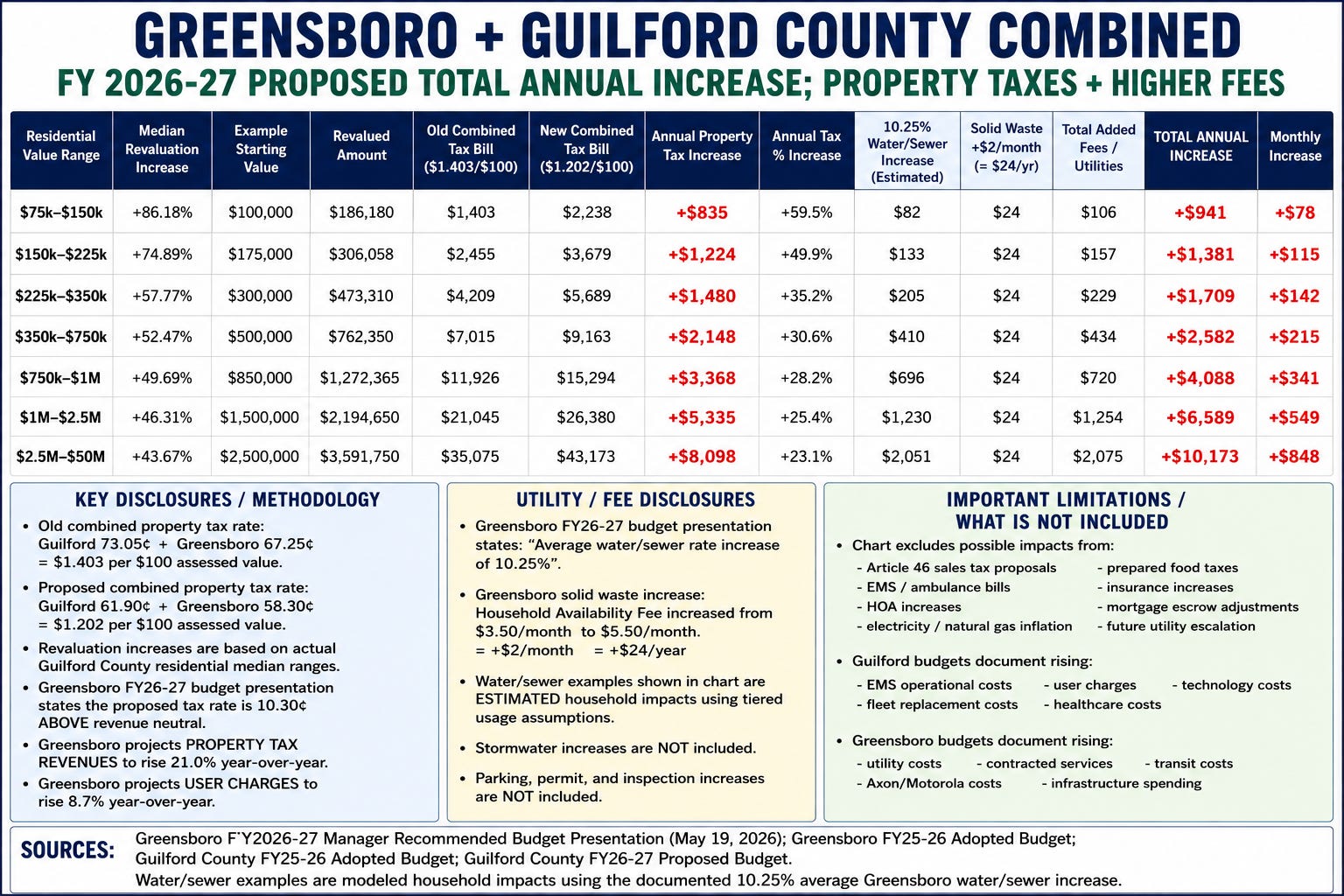
How much can our community realistically absorb before running out of money?
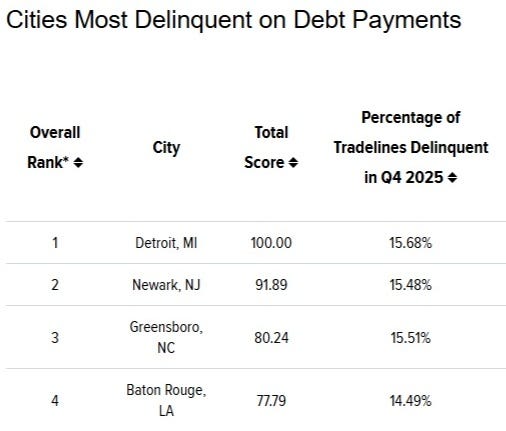
WalletHub ranked Greensboro near the top nationally for delinquent bill payments, with roughly 15% of residents behind on accounts among the 100 largest U.S. cities.
Guilford County’s poverty rate is roughly 14%, while Greensboro’s is closer to 18%.
The public deserves clear-eyed reporting that distinguishes present conditions from distant possibilities, especially when billions in taxpayer-backed incentives and the region’s economic future are at stake, and it’s not happening.
Before asking residents for even more money, local governments owe the public a brutally honest discussion about the long-term trajectory of debt, infrastructure obligations and affordability.
What if expected jobs don’t appear, we end up in a recession, and we borrowed billions that can’t be repaid?
Borrowing billions today based on tomorrow’s hoped for and hyped up prosperity works beautifully, right up until it doesn’t.
Related;


