
A Real Greensboro Home Shows Why Walter Johnson's “70% Tax Cut” Claim Falls Apart
Campaign Soundbites vs. Tax Reality in Guilford County

As property owners across Greensboro open their revaluation notices, bold campaign promises are gaining traction, including one claim homeowners could see their taxes reduced by as much as 70%.
As the News & Record reports;
Walter T. Johnson III, a Democratic candidate in the primary for the District 7 seat, took to Facebook last week as many homeowners in Guilford County were receiving notices showing their new property values.
Referring to the increases as staggering, Johnson said he had a plan that would allow homeowners to enjoy the higher equity in their homes while cutting the potential new tax burden by as much as 70%.
"Something has to be done about the tax rate," Johnson said. "We will reduce your taxes."
But a closer look at a real home in my neighborhood tells a very different story. Consider 600 XYZ Road in northern Greensboro, located in Guilford County.
The Actual Numbers
Current assessed value: $145,400
New appraised value: $260,400
Increase: 79%
The increase is well above the estimated countywide average of roughly 42–43%.
The current combined county and city tax bill;
County: $1,062
City: $978
Total: $2,039.97
Now let’s apply the campaign rhetoric to this real-world example.
What Happens Under Revenue Neutral?
Revenue neutral means the county adjusts the tax rate downward so total revenue stays roughly the same overall.
Using estimated revenue-neutral rates (about 51¢ county and 47¢ city), this home’s new tax bill would be approximately;
County: ~$1,335
City: ~$1,230
Total: ~$2,565
That is an increase of roughly $525, or about 26% higher than today’s bill.
That is not a tax cut.
It is not a 70% reduction.
It is a significant increase.
Why? Because this home appreciated far more than the county average, which from Public Integrity Watch research, dramatically effected lower valued properties more than higher priced residences.
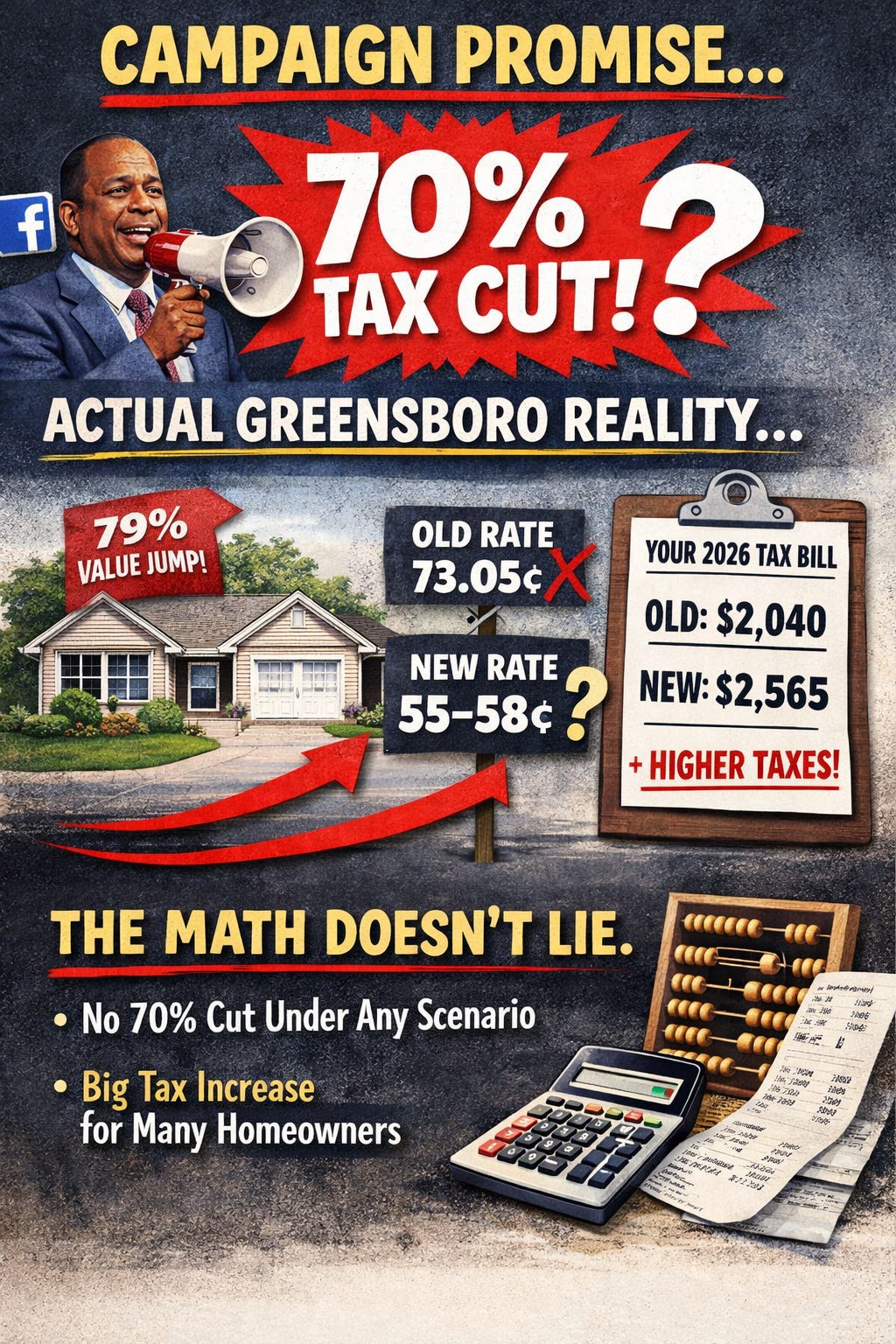
The 70% claim is based on comparing a lowered rate (55–58 cents) to a scenario where the current 73.05-cent rate stays in place after revaluation.
From Kevin Griffin at the News & Record;
Johnson said the number was based on a tax rate of 55 to 58 cents per $100 of value, which he described as a more revenue-neutral rate that he would support if elected. That range is 15 to 18 cents lower than the current tax rate of 73.05 cents.
Johnson then used what he described as a typical example: a home previously valued at $250,000, which grew to $370,000 following a 48% increase in valuation.
Doing the math on Johnson’s example shows a reduction of between 76.2% and 63.5% below what the hypothetical homeowner would have paid if the tax rate had remained the same. Actual dollar savings would range from $556 to $668.
Scott Yost at the Rhino Times reports leaving the rate the same as valuations went up would bring in another $175 million to just Guilford County per year;
Chairman Alston: The County Won’t Keep All $175 Million A Year – But Your Tax Bill Is Going Up
...if county commissioners were to keep the property tax rate exactly the same under the sharply increased 2026 revaluation, the county would take in about $175 million in additional revenue every year.
The last time the county underwent a revaluation under the Democrat-majority board, commissioners left the tax rate unchanged and brought in roughly $92 million more annually – and spent or committed every dime of it.
This time, Chairman of the Guilford County Board of Commissioners Skip Alston says that won’t happen.
Alston also made it clear that the county is not planning to adopt a revenue-neutral rate – the rate that would bring in the same total revenue as last year despite higher property values.
In other words, just because your property value went up 50 percent, 60 percent or even more doesn’t mean your tax bill will rise by that same percentage. But your tax bill is going up. The question now is how much.
“We’re going to need some of it,” he said of the projected $175 million that would come in if the rate stayed the same.
...Property owners across Guilford County are going to feel the impact of this revaluation.
The only question left is how hard they are going to feel it.
Johnson’s “70% reduction” is calculated against a hypothetical spike that is unlikely to occur.
For the XYZ home;
The owner would still likely pay more than they do today because their value jumped nearly 80%.
The only way this property would see any tax drop is if the rate were set dramatically below revenue neutral, which isn’t going to happen.
The Core Problem With the Framing
The 70% figure measures the difference between;
Keeping the old rate after a value spike, versus
Lowering the rate after revaluation
It does not measure;
A 70% drop in total taxes
A 70% drop in someone’s current bill
Or a 70% drop under revenue neutral
The distinction matters.
When homeowners in neighborhoods like mine run actual numbers, many will see increases, not dramatic cuts.
Why This Matters
Revaluation redistributes the tax burden based on relative appreciation.
If a home;
Increased less than average; taxes may drop under revenue neutral, mostly for higher valued homes as the mid and bottom range appear to have increased in value the most due to affordability with higher interest rates.
Increased about average; taxes may still rise per Skip Alston.
Increased well above average; taxes rise, even if rates fall below revenue neutral.
At 79% appreciation, 600 XYZ Road clearly falls into the third category.
Walter Johnson’s campaign messaging implies sweeping 70% reductions risks confusing homeowners who will not experience anything close to that outcome.
When applied to a real house in a real neighborhood, it’s just about impossible for Johnson to deliver on his suggestions.
Look at your revaluation notice and calculate what different rate scenarios actually mean for the property.
For many homeowners in Greensboro, especially for the middle and bottom of valuation metrics, the result will not be a 70% tax cut, it will be a higher bill.
Commissioner Frankie Jones, who currently represents District 7, also weighed in on the revaluation discussion at a meeting of the county commissioners last week.
Without naming Johnson or anyone else, he castigated community leaders who have been “playing politics with people’s emotions.”
For a real home in a real Greensboro neighborhood, one that rose 79% in value, there is no scenario on the table that produces anything close to a 70% tax cut. Not under revenue neutral. Not under the mid–50 cent rate Johnson cites. Not under the political reality described by Chairman Alston.
The only way that house sees a dramatic reduction is if county leaders slash the rate far below revenue neutral, a move that would blow a massive hole in the budget and contradict every public statement from current leadership.
That’s the difference between a talking point and a tax bill.
For many families in Greensboro, especially in middle- and lower-valued neighborhoods where appreciation hit hardest, the outcome won’t be a sweeping tax cut.
It will be an increase.
And no campaign slogan can repeal math.
Related;


