
Guilford County 2026 Property Revaluation; Data and Methodology Records Request
With links to related posts

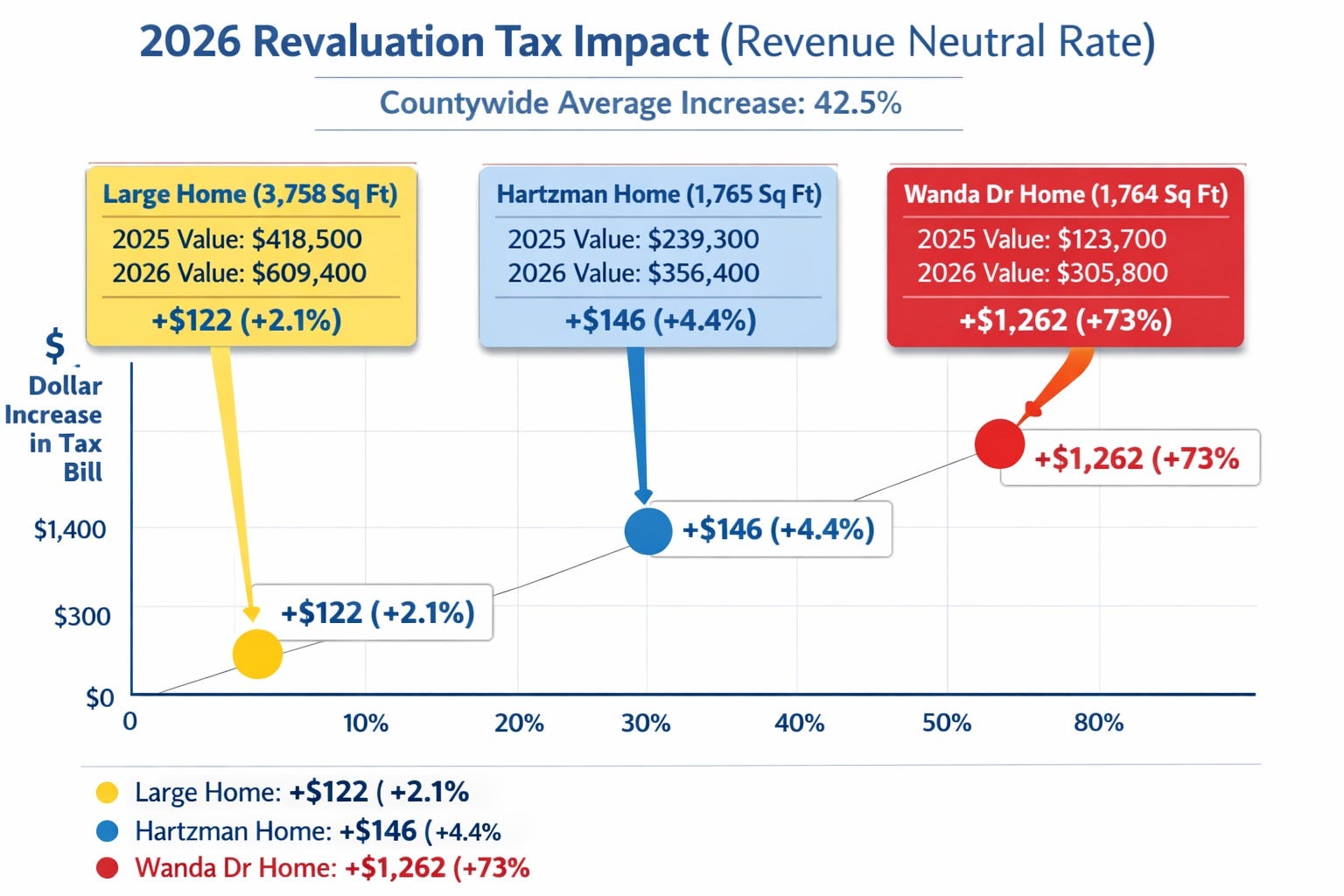
The Mayor of Greensboro’s house, my house and another I ran into.
“Revenue-neutral” only offsets the average increase. Properties that went up far more than the average end up paying a much larger dollar and percentage increase.
Meanwhile;
Larger homes with smaller relative increases (like the 3,758 sq ft property) barely see their bills rise.
Mid-sized homes like mine take a moderate hit, slightly above average.
This is a classic example of vertical inequity in property tax revaluations;
Lower-priced, previously undervalued homes can get hit the hardest.
Higher-priced homes often see only minor increases, even if their nominal values are huge.
It shifts the burden downward, despite the “neutral” label.
Despite a “revenue-neutral” valuation adjustment by Greensboro and Guilford County, the 2026 revaluation reveals a stark reality; homeowners with smaller or previously undervalued properties are facing the largest tax increases, while larger or already high-value homes will likely see only modest changes. In practical terms, this means that those least able to absorb rising costs are paying the steepest share of the tax burden. The uneven nature of these increases underscores the urgent need for transparency, accountability, and a revaluation process that ensures all residents are treated fairly, rather than quietly shifting costs onto the most vulnerable homeowners.
Pursuant to the North Carolina Public Records Law (N.C. Gen. Stat. §132-1), I respectfully request access to and copies of the following records related to Guilford County’s 2026 property revaluation;
1. Total taxable value for FY 2025 (the year immediately prior to the 2026 revaluation)
Total 2025 tax base by property class (residential, commercial, industrial, agricultural, etc.)
Total 2026 tax base by property class
Any exclusions or adjustments used in the calculations
2. Property Class Base Changes
Aggregate assessed value totals for 2025 and 2026 by property class
Percentage change in assessed value by class
Any internal analysis prepared regarding shifts in tax base composition
3. Market Area and Neighborhood Factors
Market area codes and neighborhood delineation maps
Neighborhood market adjustment factors used in the 2026 revaluation
Documentation showing how these factors were derived or calibrated
Sales ratio studies or coefficient of dispersion (COD) studies conducted for the 2026 revaluation
4. Cost and Depreciation Schedules
The locally adopted cost schedules used in the 2026 revaluation
Depreciation tables applied to residential properties
Quality grade definitions and adjustment tables
Land valuation schedules by market area
(If portions of the cost manual are proprietary, I request any locally adopted schedules, multipliers or adjustment factors used by Guilford County in applying the system.)
5. Comparable Sales Data
The sales dataset used to calibrate residential market values for the 2026 revaluation, including:
Sale dates
Sale prices
Parcel identification numbers
Market area assignments
Any exclusion criteria applied
Guilford County Public Records
Your record request #26-200 has been submitted successfully.
Thank you for contacting Guilford County. We have received your request and are working to determine if there are any responsive documents.
Public Records Request; 2026 Revaluation Distributional Impact Data
To: Guilford County Tax Department
Pursuant to the North Carolina Public Records Law (N.C. Gen. Stat. §132-1), I request access to and electronic copies of records sufficient to determine how the 2026 revaluation affected residential properties across different value tiers.
Specifically, I request the following;
1. Residential Value Distribution; Pre-Revaluation
For the last fiscal year immediately prior to the 2026 revaluation (FY 2025), please provide:
Total number of residential parcels
Assessed value of each residential parcel (parcel-level dataset preferred)
OR, if parcel-level data is not provided, a distribution table showing:
Number of residential parcels by assessed value ranges (e.g., <$150,000; $150k–$250k; $250k–$500k; $500k–$750k; $750k+)
2. Residential Value Distribution; Post-Revaluation (2026)
For FY 2026;
Assessed value of each residential parcel (parcel-level dataset preferred)
OR value distribution table using the same value bands as above
3. Change Analysis
Any internal analysis, summary tables, or reports showing:
Median residential assessed value in FY 2025
Median residential assessed value in FY 2026
Average percentage increase for residential parcels
Percentage increase broken out by value tiers (low, median, high value homes)
Any decile, quartile, or tier-based analysis conducted by the County
4. Sales Ratio and Equity Studies
Any coefficient of dispersion (COD), price-related differential (PRD), or vertical equity studies conducted in connection with the 2026 revaluation
Any analysis evaluating uniformity of assessment across value strata
If parcel-level data is provided, I request it in spreadsheet format (CSV or Excel), including;
Parcel identification number
2025 assessed value
2026 assessed value
Property class designation
Market area code
If any portion of these records is withheld, please cite the specific statutory basis for denial.
These records are requested to evaluate the distributional impact of the 2026 revaluation across residential value tiers.
Guilford County Public Records
Your record request #26-201 has been submitted successfully.
Public Records Request; 2026 Revaluation Equity & Calibration Data
To: Guilford County Tax Department
Pursuant to the North Carolina Public Records Law (N.C. Gen. Stat. §132-1), this is a supplemental request related to the 2026 property revaluation.
I request the following records;
1. Vertical Equity and Uniformity Studies
Any analyses conducted in connection with the 2026 revaluation measuring assessment uniformity or vertical equity, including;
Coefficient of Dispersion (COD) studies
Price-Related Differential (PRD) calculations
Stratified sales ratio studies by value tier
Decile or quartile-based assessment ratio analyses
Any regression output or statistical modeling used to test value uniformity across price ranges
If no such analyses were performed, please confirm in writing.
2. Sales Calibration Data
Records sufficient to show how residential market values were calibrated, including;
The sales cutoff date used for 2026 calibration
The full dataset of arm’s-length residential sales used in modeling (parcel ID, sale date, sale price, market area)
Criteria for excluding sales from analysis
Any weighting adjustments applied
Any documentation describing how changing market conditions (including interest rate increases) were incorporated into the valuation model
Electronic format (CSV or Excel) is preferred.
3. Neighborhood Market Adjustment Factors
The neighborhood or market area factor tables used for 2026
Documentation reflecting changes in market factors from the prior revaluation cycle
Any internal memoranda or reports explaining factor adjustments
4. Land and Improvement Modeling
Aggregate residential land value totals for FY 2025 and FY 2026
Aggregate residential improvement value totals for FY 2025 and FY 2026
Residential land valuation schedules by market area
Any revisions to land pricing tables adopted for 2026
5. Appeals and Informal Review Data (When Available)
Total number of informal review requests filed for 2026
Number and percentage resulting in value adjustments
Average percentage reduction granted
Distribution of reductions by value tier, if tracked
Guilford County Public Records
Your record request #26-202 has been submitted successfully.
Public Records Request; Median Residential Revaluation Data
To: Guilford County Tax Department
Pursuant to the North Carolina Public Records Law (N.C. Gen. Stat. §132-1), I am requesting the following information related to the 2026 residential property revaluation:
Requested Records;
Median-value home assessment changes for 2026
Median assessed value of residential properties for 2025
Median assessed value of residential properties for 2026
Median percentage increase by market area or neighborhood, if available
Any supporting data tables, reports, or calculations used to determine these median values
Stratified median information
Median increases for low-, mid-, and high-value residential properties, broken into deciles or quartiles
Documentation or calculations showing how these stratified medians were derived
Methodology Documentation
Any internal guidelines, formulas, or reports used to calculate the median and stratified median changes
Clarification on whether the median calculations account for sales exclusions, property exemptions, or abnormal market adjustments
Explanation of Request:
The purpose of this request is to evaluate the distributional impact and fairness of the 2026 revaluation. While the county has published average (mean) increases, averages can be skewed by extreme property value changes, making it difficult to understand the typical homeowner’s experience. Median values provide a more accurate picture of how most residents’ assessments changed and help identify whether the revaluation produces disproportionate tax impacts on lower- or higher-value homes.
Providing these records will allow independent analysis of vertical equity in the revaluation and support transparency in the property tax system.
Guilford County Public Records
Your record request #26-203 has been submitted successfully.