
Frozen Deal? How an SBI Probe May Have Halted the Controversial Bellemeade Parking Lot Sale to Roy Carroll in Greensboro
The $2.9 Million Question; Was It an Engineering Failure or a Political Favor?

On June 09, 2025, Public Integrity Watch published “Greensboro’s $2.9 Million Bellemeade Boondoggle: How Taxpayers Bankrolled Roy Carroll’s Profits Through Illegal Lobbying by DGI CEO Zack Matheny and City Council Votes”, which uncovered millions in taxpayer losses stemming from a demolition-and-sale process disproportionately benefiting developer Roy Carroll, a major political donor with close ties to city leadership.
Downtown Greensboro Inc.’s (DGI) Zack Matheny lobbied the City of Greensboro with taxpayer monies received via a government contract with the City while he was an elected councilman.
The $2.9 Million Breakdown
Public records confirm;
$2,354,000; City-paid demolition of the Bellemeade deck (approved February 2025)
$570,000; Difference between post-demolition appraisal ($2.42M) and sale price to Carroll ($1.85M)
Total Loss to taxpayers; $2,924,000
Profit for Roy Carroll; $2,924,000 via a no-bid contract
The same Record; Total Appraised Value - Valued by Cost - $12,415,300
Greensboro taxpayers first paid to demolish the deck, then City Council voted to sell the soon to be cleared land at a steep discount, effectively subsidizing Carroll’s deal. Matheny voted for both in violation of state law, Greensboro’s Code of Ethics and DGI’s contract with the City.
Current public property records reveal a stark anomaly; Two city-owned parking decks, voted on for sale on the same day on June 5, 2025, now have two different owners. The Davie Street Deck is listed under a private LLC connected to a Barry Siegal related LLC;
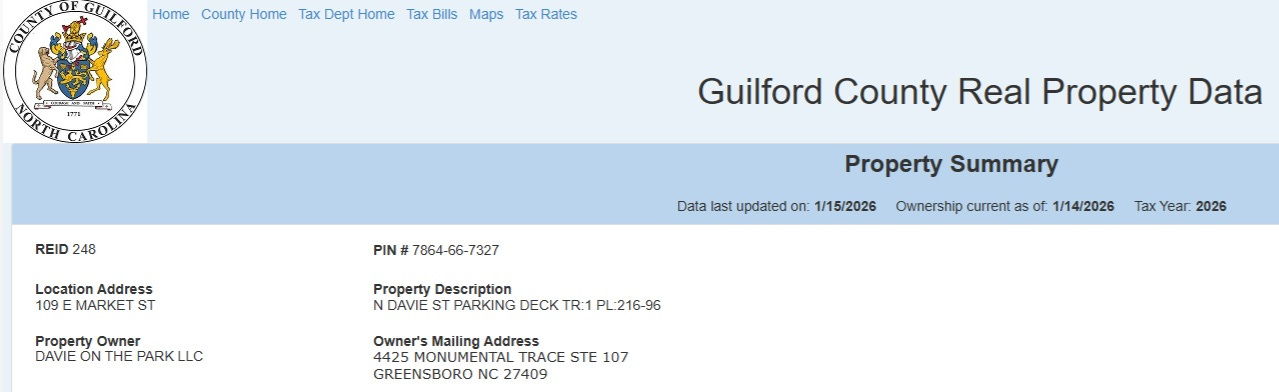
The Bellemeade Street property, however, still shows as owned by the City of Greensboro;
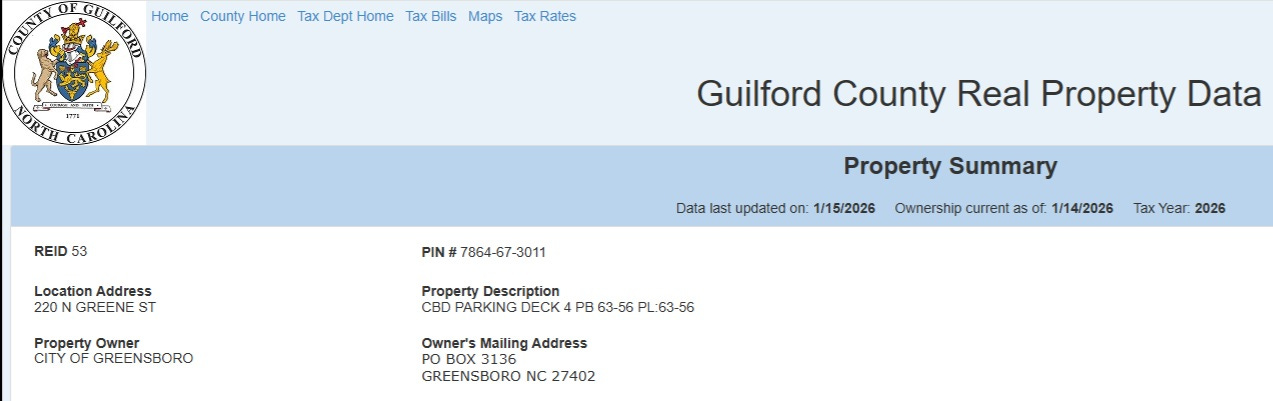
This administrative limbo is evidence of allegations surrounding the Bellemeade deck deal, illegal lobbying, misuse of public funds, conflicts of interest and taxpayer loss, which may have been part of what triggered a state level SBI investigation which could have frozen the transaction.
Samet Corporation made a less than two page recommendation concerning the Bellemeade Parking Deck in June, 2024 ;
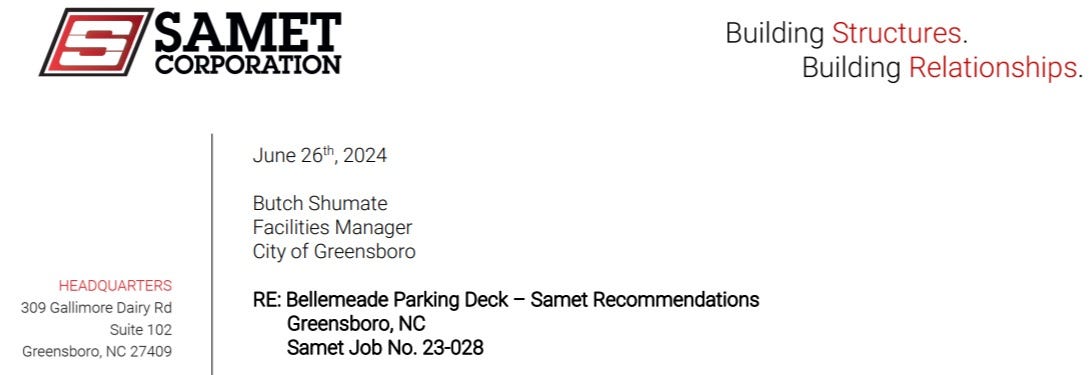
Both Samet and Carroll are members of TREBIC, the Triad Real Estate Building Industry Coalition led by former NC House of Representative and former deputy Majority Whip Jon Hardister. Arthur Samet is a DGI board member along with Roy Carroll’s employee Craig Carlock. Public records show Zack Matheny’s DGI paid for a $300.12 lunch with Roy Carroll and Arthur Samet at Undercurrent Restaurant on December 5, 2023. Both are Zack Matheny political campaign contributors.
The letter states;
Samet is concerned the proposed repair may not be a viable solution to the current issues at Bellemeade Deck. There is major concern for the ability to ensure the safety of Samet personnel, subcontractors, and pedestrians in the vicinity of the construction zone due to the weight of materials required to be placed on the top-level during repairs.” And “it is Samet’s opinion that the proposed repairs would only provide temporary solutions and possibly a few years to the serviceability of the structure.”
...In summary, it is Samet’s opinion that the Bellemeade Deck will continue to degrade on multiple parking levels and in different ways due to its age and maintenance history. Repairs associated with the degradation shown will be costly, not provide long term correction, could prove unsafe to execute, and will be continuous in multiple areas that are currently unforeseen. This could lead to near endless expenditure “chasing issues” that will only provide short term solutions and may still leave the deck unsafe to use.
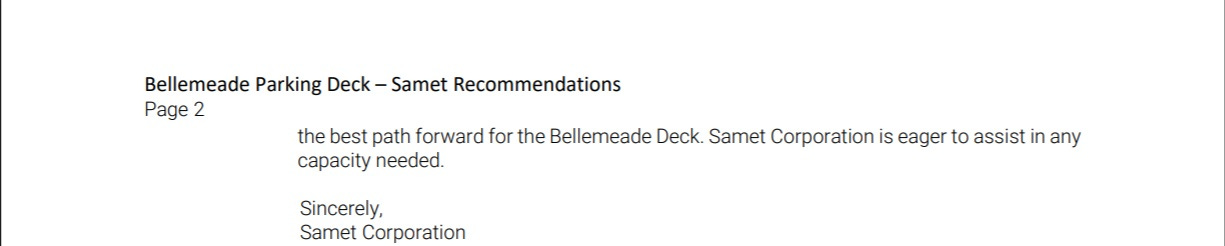
We hope this letter is helpful to the City of Greensboro in deciding the best path forward for the Bellemeade Deck. Samet Corporation is eager to assist in any capacity needed.
Sincerely,
Samet Corporation
Samet provided a seemingly legitimate, expert rationale for demolition other actors could publicly point to, while obscuring private interests at play, explaining the push for demolition, which wasn’t necessarily in play at the time.
The Samet opinion was about 494 words. This is page 2;
The letter provided a powerful, public-facing argument; demolition wasn’t about land clearance for a developer, but a necessary public safety and fiscal decision. This argument, coming from an connected and established company, was wielded by DGI in its lobbying and by council members voting “yes” to deflect criticism.
The Potential Problem; Two Nonconforming Analysis; One Before and One After the Samet Complete Demolition Recommendation Letter;
A ten page January, 2024 report by SKA, which does not explicitly recommend demolition of the entire Bellemeade Parking Deck, presented three technically viable remediation options for the specific problem of cracked girders on the top level, with demolition and replacement of only those girders being just one option. The key distinction is between partial demolition (of specific components) and total demolition (of the entire structure) suggested by Samet, which later became the city’s chosen path.
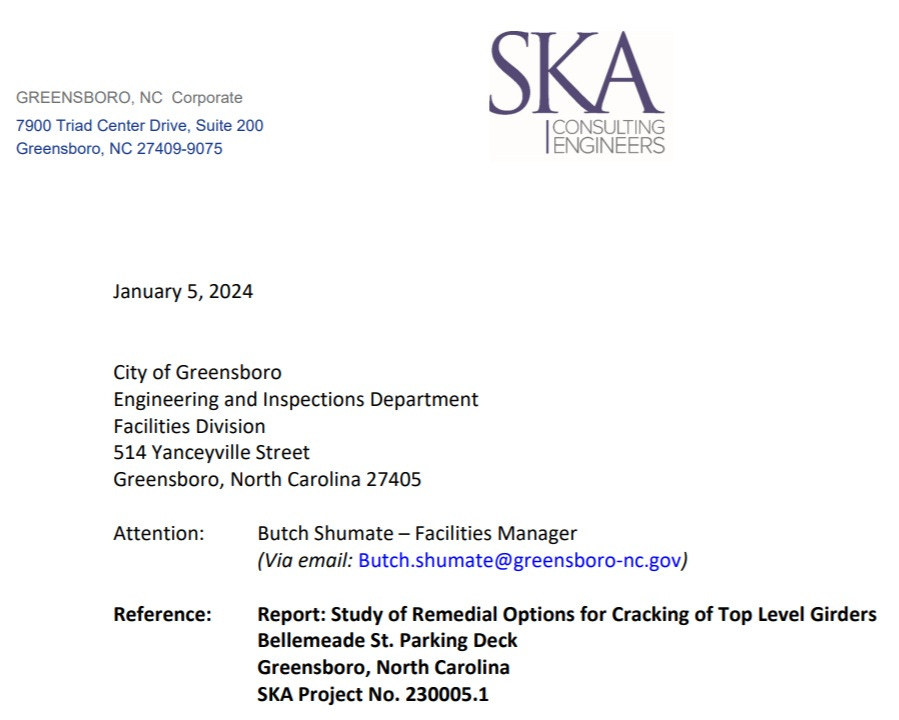
The SKA report provided a menu of engineering solutions that could have extended the deck’s life. It did not recommend tearing the deck down. The push for total demolition appears to have been a political and economic decision that emerged later, justified by the more dire assessment in the very short Samet letter and advocated for by Matheny and officials with connections to the eventual buyer.
This document shows a reputable engineering firm identifying multiple paths forward, including repair, before other actors with different interests began lobbying for demolition. One option was to Load Test the girders, and if they passed, preserve and repair them. If they failed, replace them (partial demo). The Load Test appears to have never happened.
Walter P Moore
The last review by Walter P Moore (WPM) in October, 2024, three months after the Samet letter, didn’t recommend demolition of the entire Bellemeade Parking Deck. The twenty page study provided a balanced engineering assessment, presented three specific options for the distressed top level, with total demolition not being one of them. The report confirmed significant issues but framed solutions within the context of repair and renovation.
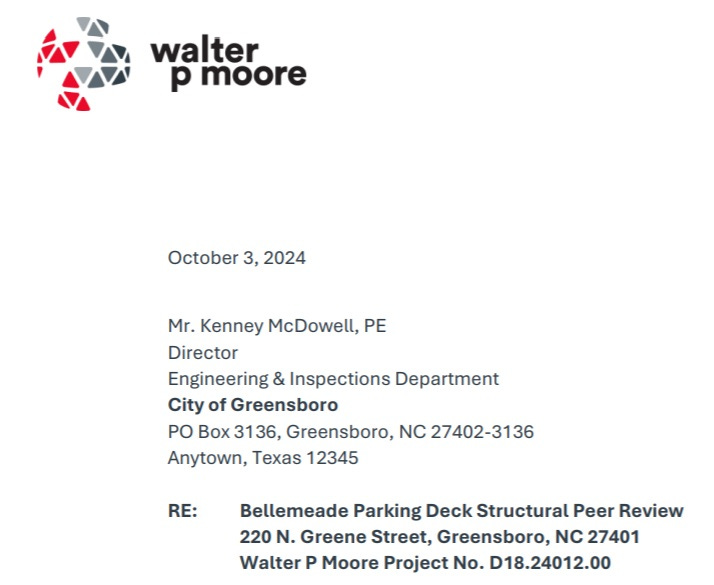
The WPM report validated serious structural problems but diverged sharply from the Samet letter in its conclusions. The review provided a technical roadmap for a major renovation, not a verdict for total demolition.
The Samet letter was noted, but WPM’s recommendation’s did not concur.
The Engineers (SKA & WPM) presented options to save and repair the structure, with varying scopes and costs. The Political/Developer Path (Carroll, Samet, Zack the Councilman & Zack the DGI CEO?) advocated for total demolition, which would conveniently clear the land for a new private development.
The WPM report significantly undermines the “public safety necessity” argument for total demolition. It showed qualified, independent engineers believed the structure could be saved with targeted repairs, making the city’s decision to pursue a full, taxpayer-funded demolition, followed by a discounted land sale, appear to be a political and economic choice, not an engineering imperative.
The Deal;
The Engineers (SKA & WPM) presented options to save and repair the structure. The Political/Developer Path (Samet & DGI) advocated for total demolition, which would conveniently clear the land for a new private development by Roy Carroll.
The deal to transfer prime public land to Roy Carroll at a significant discount, after taxpayers funded a $2.35 million demolition, may have been stopped cold by the specter of potential criminal wrongdoing.
Summer 2025-Winter 2026; The SBI investigation begins, prompted by George Hartzman ethics complaints. The Davie Street sale closes without issue. The Bellemeade sale does not. The most recent property records, current as of January 14, 2026, confirm the city still holds the land at 220 N. Greene Street.
The Bellemeade saga demonstrates how the complex interplay of public-private partnerships, political donations, and lax oversight can create a perception, or a reality of a government that works for connected insiders rather than the public.
What remains is not merely a stalled real estate transaction, but a public record telling a troubling story of how taxpayer money, political influence and conflicted decision-making converged around a single parcel of public land.
Independent engineers presented viable paths to preserve and repair the Bellemeade Deck. Those options were bypassed in favor of a demolition strategy advanced by politically connected actors, funded by the public, and structured to deliver a multimillion-dollar windfall to Roy Carroll.
The unexplained freeze of the Bellemeade transfer while a companion sale moved forward, signals regulators may have recognized the same red flags visible in the documents; illegal lobbying, misuse of public funds and engineered outcomes disguised as “public safety.” Whether or not criminal charges ultimately follow, the evidence already demonstrates a breakdown of ethical governance and fiduciary duty.
Greensboro taxpayers likely paid the price.
For ongoing updates on local investigations and government accountability, subscribe for free.
Related;


Disclaimer; This report is based entirely on publicly available records, official documents, property filings, engineering reports, recorded votes, contracts and contemporaneous news reporting, as well as reasonable analysis and opinion derived from those materials. All factual statements are presented in good faith and are supported by source documentation where cited. Interpretations, conclusions, and characterizations constitute protected opinion and fair comment on matters of public concern.
No individual or entity named herein is alleged to have committed a crime unless explicitly stated as such in verified public records or official proceedings. References to investigations reflect reported or documented governmental activity and do not imply guilt or final determination of wrongdoing. The use of terms such as “may,” “appears,” “suggests,” and “potential” reflects uncertainty where facts are not yet fully adjudicated.
This publication is intended solely to inform the public about the expenditure of taxpayer funds, government decision-making, ethical compliance and transparency in public institutions. It does not assert intent, motive or criminal liability beyond what can be reasonably inferred from documented evidence. Readers are encouraged to independently review the underlying records and reach their own conclusions.
If any factual inaccuracies are identified, corrections will be promptly issued upon verification.