
Formal Objection and Notice to City Council; Item G.20
Re: December 16, 2025 Budget Adjustment; Tanger Center Founders Room Project

To the Members of Greensboro’s City Council;
This communication serves as a formal objection and notice regarding the proposed December 16, 2025 vote to approve a budget adjustment transferring $789,500 within the Tanger Capital Improvements Fund (2992 Coliseum) to effectuate payment for the Tanger Performing Arts Center Founders Room Project.

You are hereby advised that voting to approve this accounting transfer would implicate the current City Council in ratifying, aiding and abetting an unlawful prior vote, and would expose participating members to legal, ethical and potentially criminal liability.
1. The Underlying Contract Was Approved Through an Illegal Vote
On November 18, 2025, the prior City Council approved Resolution 2025-849, awarding a $789,500 contract for the Tanger Center Founders Room renovation. That vote was taken without recusals by Mayor Nancy Vaughan and Councilmembers Zack Matheny, Jamilla Pinder and Nancy Hoffmann, despite their service on the nonprofit Tanger Center board, along with City Manager Trey Davis.
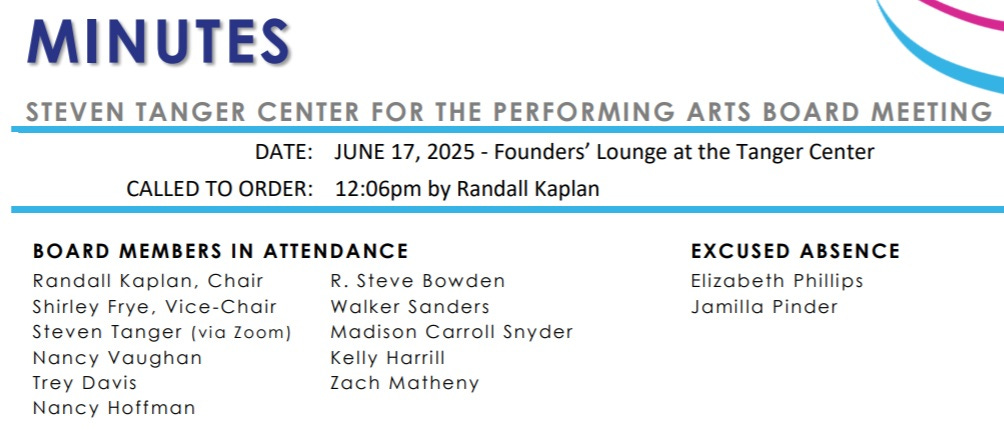
This vote implicates North Carolina General Statute § 14-234.3, which prohibits public officials from voting on or influencing contracts or appropriations involving nonprofit organizations on whose boards they serve. The statute does not require proof of personal financial gain. It prohibits the act itself.
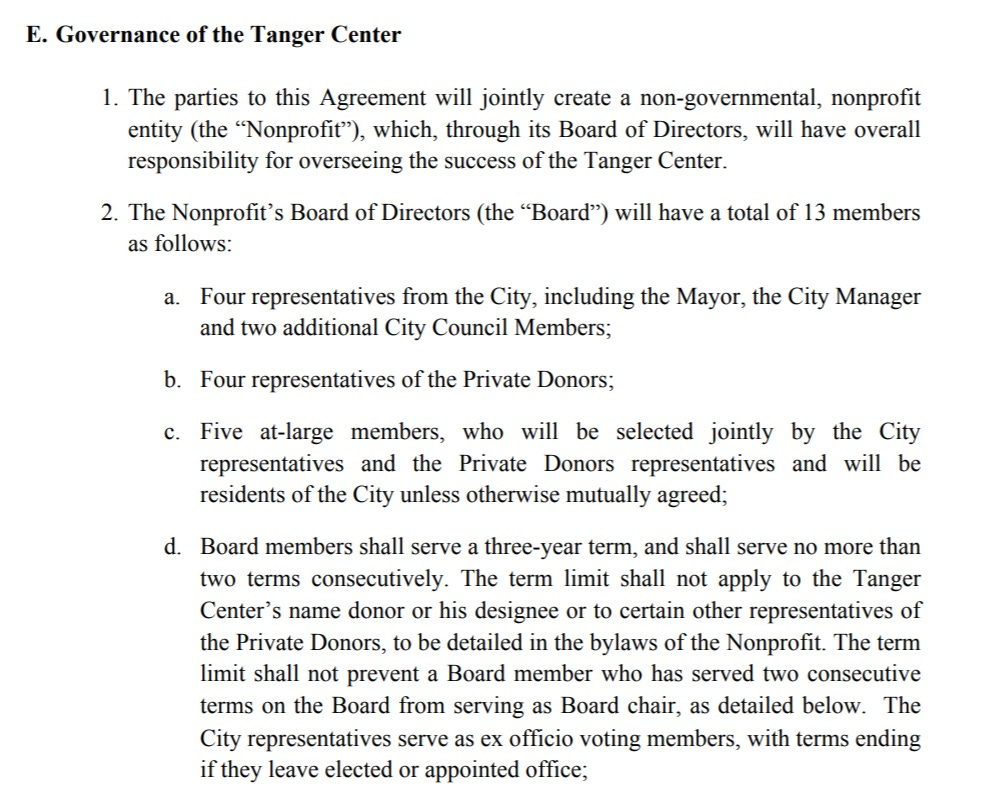
An illegal vote cannot be cured by later accounting actions.
2. The December 16 Vote Is Not a Neutral Accounting Matter
The proposed agenda item seeks to move funds as follows;
FROM: Buildings 523-75-7521001.6013; $789,500
TO: Buildings 523-75-7521002.6013; $789,500
This transfer is expressly described as being “to reflect the contract award for the Tanger Performing Arts Center Founders Room Project and for proper accounting thereof.”
In plain terms, this vote would implement and pay for a contract approved through an illegal vote.
From “ETHICS FOR LOCAL ELECTED OFFICIALS; 2025 Local Elected Leaders Academy” by UNC’s School of Government;
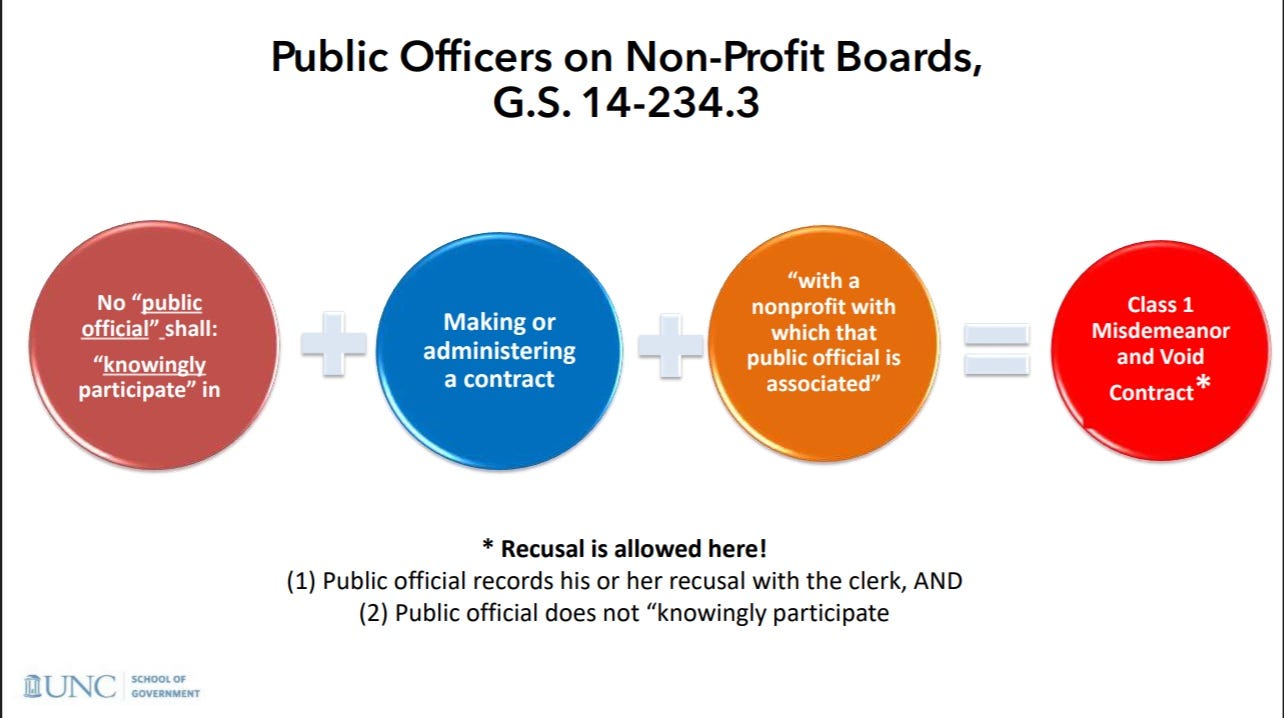
By approving this transfer, the current Council would be;
ratifying an unlawful action,
facilitating the expenditure of public funds pursuant to that action, and
becoming complicit in its continuation.
North Carolina law does not allow a governing body to “paper over” an illegal vote through subsequent administrative or financial approvals.
3. Aiding and Abetting Exposure
Under North Carolina law, knowingly assisting, enabling, or furthering an unlawful act, including through financial implementation, can constitute aiding and abetting.
The current Council has now been placed on notice of;
the statutory prohibition,
the conflicted votes,
the lack of recusals,
and the failure of internal safeguards.
At least twice.
Proceeding with the December 16 vote despite these notices would eliminate any claim of ignorance and materially increase individual exposure.

4. Failure to Supervise and Breakdown of Legal Oversight
The November 18 vote also reflects a failure of supervision by the prior Council.
Members did not ensure that;
the City Attorney provided correct legal guidance, or
conflicted members were prevented from voting,
even though earlier in the same year, Mayor Vaughan, Councilmembers Holston, Thurm and Matheny recused themselves on G.S. 14-234.3 related matters for the same reasons.
City Attorney Lora Cubbage nevertheless allowed the November 18 vote to proceed without intervention. The City Attorney has a legal duty to identify conflicts, advise Council of statutory prohibitions and protect the validity of Council actions. A failure to do so raises professional responsibility concerns, potential malpractice exposure, and, if knowing, possible criminal implications.
5. Additional Appearance-of-Impropriety Concerns
These issues are compounded by the fact that City Attorney Cubbage received judicial campaign contributions from multiple City Council members and senior city officials, including individuals involved in or connected to the challenged actions. While campaign contributions are lawful, they heighten the appearance of compromised independence when the City Attorney fails to restrain conflicted votes involving those same officials.
6. Binding Ethical Obligations of the Current Council
Greensboro’s Code of Ethics, adopted pursuant to N.C.G.S. § 160A-86, requires Council members to:
act with integrity and independence from improper influence,
avoid impropriety in the exercise of official duties, and
ensure that official actions are above reproach.
Voting to move funds to pay for a contract approved through an illegal vote would violate both the letter and spirit of these obligations.
7. Required Course of Action
Accordingly, the undersigned formally urges the City Council to;
Decline to vote on the December 16, 2025 budget adjustment;
Segregate and halt any payment related to the Founders Room contract;
Refer the November 18 vote for independent legal review, outside the City Attorney’s office; and
Refrain from any action that could be construed as ratification of the prior unlawful vote.
The Council should then either void the contract or re-authorize it through a clean, conflict-free process, with all conflicted officials fully recused and the City Manager excluded.
This objection is submitted to protect the City, the Council, and the public.
Once notified of an illegal action, inaction or continuation becomes participation.
The safest, lawful, and ethical course is not to vote and re-authorize a clean, conflict-free process.
Thanks,
g
Related;


Disclaimer;
As of the date of publication, City of Greensboro staff and Greensboro Coliseum/Tanger Center staff have not publicly identified the name of the nonprofit entity associated with the Tanger Performing Arts Center that is referenced in the Tanger MOU, City agenda materials and public discussions. This analysis therefore relies on the City’s own descriptions of a nonprofit governance structure connected to the Tanger Center and on publicly available information regarding board service by elected and appointed officials. If the City or Coliseum staff subsequently clarifies the identity, legal status or role of the nonprofit entity, this information should be disclosed and evaluated, as it may materially affect the legal and ethical analysis presented here.