
An Open Letter to Greensboro's City Council; Lora Cubbage Cleared Her Own Client; Why the City Attorney’s Ethics Determination on Mayor Marikay Abuzuaiter Must Be Rejected
Who Reviews the Reviewer? Demanding an Independent Look at the Mayor and City Attorney

Dear Mayor Pro Tem Roth and Members of the City Council,
I formally challenge City Attorney Lora Cubbage’s May 28, 2026 ethics determination dismissing complaints filed by George Hartzman and C.J. Brinson against Mayor Marikay Abuzuaiter. The determination contains a pattern of legal and analytical errors that consistently point in one direction; exoneration of the City Attorney’s own client.
The central issue before Council is not whether every allegation has been proven. It is whether a City Attorney whose own advice, actions and office are implicated should have served as the sole decision-maker on whether those allegations warranted independent investigation.
Cubbage’s determination is not merely incorrect; it is the product of self-review that the Ethics Policy’s outside-counsel provision, which she drafted and this City Council approved, was designed to prevent.
I respectfully request the Council;
1. Find that the determination arose from a structurally conflicted process and reflects a predetermined outcome;
2. Refer the Hartzman and Brinson complaints to a truly independent outside investigator, neither selected nor supervised by the City Attorney’s office;
3. Immediately preserve all records related to GSF hospitality, the Hunden Partners dinner, and all communications concerning these ethics complaints; and
4. Consider forwarding this matter to the North Carolina State Bar for review of potential violations of Rules 3.3 (Candor) and 8.4 (Misconduct).
I. Structural Conflict
The City Attorney declined to refer these complaints to independent counsel, as expressly permitted by the Ethics Policy, and instead cleared her own client. The consistent direction of the errors identified below underscores the concern; this was not neutral review, but self-adjudication. The outside-counsel provision exists precisely to prevent that outcome.
From Cubbage’s Determination;

The Ethics Code requires an outside investigator to be free from both actual and apparent conflicts regarding the complainant, the subject of the complaint and the subject matter of the complaint.;

Yet the threshold determination was made by an individual whose legal advice, interpretation of the ethics rules, and handling of the complaint process were themselves at issue.
If an outside investigator with the same connections to the subject matter would be disqualified under subsection D.2.f, why should those same appearance concerns be disregarded when the City Attorney decides whether the complaint reaches an outside investigator in the first place?
Was the City Attorney’s advice challenged by the complaints? YES
Was the City Attorney’s conduct or handling of prior ethics matters challenged by the complaints? YES
Was the City Attorney interpreting a policy she drafted? YES
Was the City Attorney deciding whether allegations involving her own legal advice should proceed to outside review? YES
The appearance concerns the policy seeks to avoid for outside investigators were present at the threshold-review stage as well.
Hartzman asked for Lora Cubbage’s recusal from the process in his initial complaint;
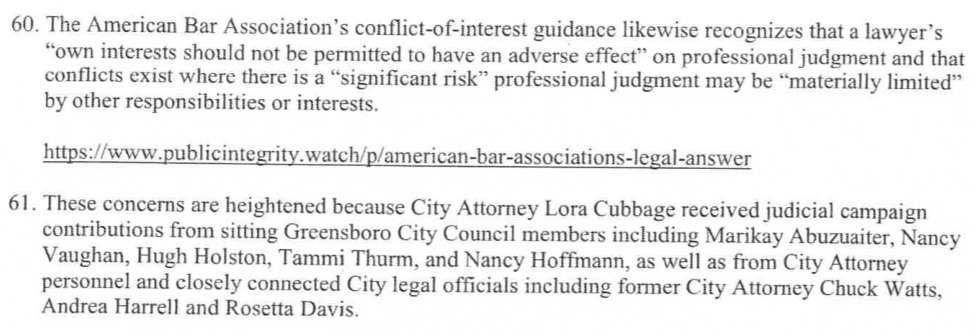
And;
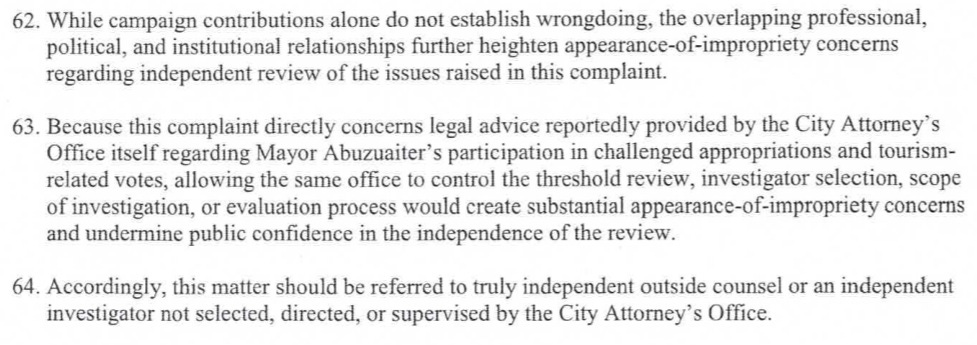
Before any determination was made, I requested the City Attorney's recusal because the complaint implicated her legal advice, actions, and role in the matters at issue. Despite that request, she decided for herself whether the complaint should advance to an outside investigator. The conflict concern was therefore presented before the review began, not raised afterward in response to an unfavorable outcome.
The determination spends roughly five pages arguing why the outside law firm was not conflicted, but does not contain a similar analysis explaining why the City Attorney was not conflicted, despite the request for her recusal in the complaint.
II. Analytical Failures
From Lora’s Ethics Code;

A. Misuse of §§ 14-234 and 14-234.3;
The determination states: “Both statutes tie the gift prohibition to a quid pro quo; the gift must be linked to the official’s effort to influence a contract.” N.C.G.S. §133-32, cited in the Ethics Code Lora Cubbage wrote above, doesn’t have “quid pro quo” or “in exchange language”, hence the point of the legislation;
https://www.ncleg.gov/enactedlegislation/statutes/html/bysection/chapter_133/gs_133-32.html

N.C.G.S. §133-32 flatly prohibits a contractor from making gifts or favors to covered officials, and prohibits covered officials from willfully receiving them. No “in exchange for” element appears in the operative language.
The only exceptions are enumerated in subsection (d); and a private dinner organized by a contractor for a paid consultant, attended by the City Manager, and the contractor’s president, fits none of them. Mayor Abuzuaiter RSVP’d to the GSF cocktail party and failed to prevent a §133-32 violation on the Hunden dinner, as she was invited and knew it was to occur.
From the City Attorney’s determination;
Unless there is evidence that mayor is receiving benefits (invite to holiday party) in exchange for influencing the award of contracts to or from GSF, the gift prohibitions of §§ 14-234, 14-234.3 nor 133-32, and the Code of Ethics and Gift Policy are not triggered by her attendance.
Adding a quid pro quo requirement to §133-32 is not interpretation; it is revision of the statute.
For the Giver (GSF/Richard Beard); It is unlawful for a contractor or supplier “to make gifts or to give favors” to an official charged with administering contracts. The act of making the known gifts is itself a violation.
For the Recipients (Mayor Abuzuaiter, City Manager Trey Davis and Assistant Manager Larry Davis); It is likewise unlawful for a qualifying official to “willfully receive or accept any such gift or favor”
The invitations are attempts to provide something of value. The “favor” being given is the opportunity to participate in events that could improperly influence a public official.
N.C.G.S. §133‑32(d) requires any gift from a contractor to be reported to the agency head. The determination never asked whether the Hunden dinner or the catered cocktail party was reported by anyone.
The City Attorney claims the holiday party and similar events are not prohibited. The statute, however, only carves out narrow exceptions;
Meals furnished at banquets (public events, not private invitation‑only dinners)
Donations to professional organizations where the official is a member (GSF is not a professional organization of which the Mayor is a member in her professional capacity)
Customary gifts between friends and relatives “where it is clear that it is that relationship rather than the business of the individual concerned which is the motivating factor”
The relationship between a mayor and the president of a taxpayer‑funded nonprofit contractor is not a friendship exception. And even if such an exception could be argued, subsection (d) imposes a mandatory reporting obligation; “all such gifts knowingly made or received are required to be reported by the donee to the agency head if the gifts are made by a contractor, subcontractor, or supplier doing business directly or indirectly with the governmental agency employing the recipient of such a gift.” The determination never asked whether any such reports were filed.
There are two relevant outstanding records requests;
32973; Gift Reports; 12-22-2025; George hartzman; 16 weeks 2 days
33004; Gift Reports 2; 12-25-2025; George hartzman; 16 weeks 1 days
At the time the determination was issued, multiple records requests concerning gifts, hospitality and related matters remained outstanding. The determination doesn’t indicate whether those records were reviewed, whether they had been produced, or whether the factual investigation was considered complete. A significant procedural concern considering the City Attorney’s conflict of interest.
An invitation to a private dinner or party is an attempt to provide something of value. The “favor” being given is the opportunity to participate in an event that could improperly influence a public official.
Adding a limiting element the legislature chose not to include is not a misreading, it is a rewriting of the statute.
B. Selective Use of the 1999 Attorney General Opinion
The determination cites the 1999 AG opinion (Gorham/NHRMC) and quotes the following: “if neither trustee will personally benefit...then in our opinion there is no violation of the statute.”
The very next sentence of that same opinion reads “The conflict transaction is the entire Partners Program grant process, and not just the grant to the nonprofit corporation with which the trustees are affiliated.”
And: “This conflict encompasses the entire process of awarding CHIP grants under the Partners Program, and not just the grant to the nonprofit corporation.”
Cubbage wrote: ‘The AG also noted that the conflict of interest provisions … apply to the entire grant process.’ But she then ignored the AG’s subsequent sentence defining what ‘entire process’ means; ‘the conflict transaction is the entire Partners Program grant process, and not just the grant to the nonprofit corporation.’
Those sentences directly undermine the determination’s central legal conclusion; that §14-234.3 applies only to direct transfers to GSF and not to appropriations flowing through intermediaries like the CVB or Coliseum Complex. The City Attorney cited the opinion, quoted it, and omitted the sentence that cuts against her client in the determination.
If true, would the Hunden dinner raise issues under §133-32, the Ethics Policy, gifts, hospitality, conflicts, or recusal obligations? The determination appears not to analyze that allegation at all.
That’s not a good-faith use of authority.
The determination acknowledges the Attorney General’s statement that conflict provisions apply to the “entire grant process.” Yet the determination never explains why that principle wouldn’t apply where public funds are routed through intermediary entities before reaching an associated nonprofit.
C. Adding “Directly” to N.C.G.S. §14-234.3
The statute provides: “No public official shall knowingly participate in making or administering a contract, including the award of money in the form of a grant, loan, or other appropriation, with any nonprofit with which that public official is associated.”
The word “directly” does not appear in §14-234.3.
https://www.ncleg.gov/EnactedLegislation/Statutes/PDF/BySection/Chapter_14/GS_14-234.3.pdf
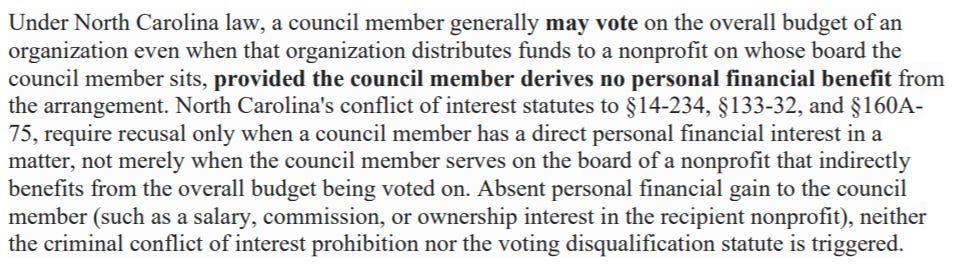
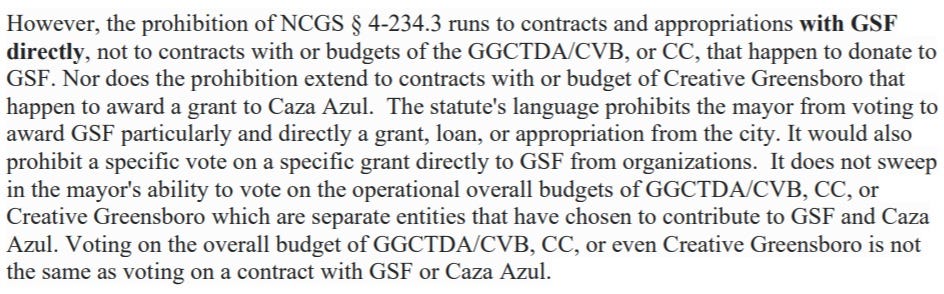
The determination states: “Only if the voting is on a direct grant or appropriation to GSF...”, and builds the pass-through defense entirely on that added word. The determination provides no authority for this construction. Courts do not add limiting words to statutes. The legislature enacted §14-234.3 in 2021 specifically to move beyond the personal-financial-benefit framework of old §14-234. The determination applies the old framework to the new statute without acknowledging the distinction.
From the determination, which fails to mention §14-234.3;
And then does, incorrectly;
D. Complete Omission of the Hunden Partners Dinner
The complaints alleged that on January 13, 2026, Mayor Abuzuaiter was invited to attend a private dinner hosted by GSF for consultant Hunden Partners, alongside City Manager Trey Davis, GSF President Richard Beard, and CVB’s Tony Cordo. Assistant City Manager Larry Davis was subsequently asked to present Coliseum debt financing tied to the Hunden engagement amongst other GSF initiatives.
The determination, despite stating that it evaluates whether the complaints state a claim “even if the allegations are true,” does not mention or analyze this allegation.
Failure to address a material, evidence-based allegation is inconsistent with the threshold review required by the Ethics Policy.
She did not.
A determination that claims to have “carefully reviewed” the complaints while omitting a documented, evidence-based allegation does not satisfy the threshold review the Ethics Policy requires. More analyses here;

III. Unsupported Pass-Through Theory
The determination’s central legal conclusion; that appropriations flowing through the CVB or Coliseum Complex to GSF fall entirely outside §14-234.3, is presented without citation to any statute, case law, or Attorney General opinion. This is the holding that clears the Mayor. It cites nothing.
Publicly available financial disclosures show substantial and recurring public funding flowing to GSF through the CVB and Coliseum Complex. The relevant legal question, as framed by the Attorney General, is whether the conflict extends to the entire funding process, not merely the final transfer.
GSF’s own 990s and financial reports reflect the following recurring funding from publicly supported entities;
• FY2022: $150,000 from CVB; $150,000 from Coliseum Complex
• FY2023: $275,000 from CVB; $150,000 from Coliseum
• FY2023 (990): $200,000 from CVB; $85,000 from City; $180,000 from Coliseum
• FY2024: $200,000 from CVB; $89,800 from City; $185,000 from Coliseum
This is not a speculative or attenuated relationship, regardless of what Cubbage claims;

The question the determination never asked is the one the 1999 AG opinion said must be asked; whether the conflict encompasses the entire funding process, not just the final transfer. The determination does not engage that question. It asserts a conclusion without authority. The word “direct” does not appear in §14-234.3;
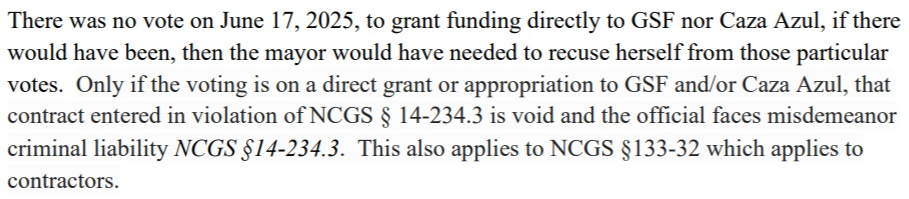
If the City Attorney believes a pass‑through structure immunizes a budget vote from §14‑234.3, she must cite a statute, case, or AG opinion. She did not. She simply asserted it.
IV. Requested Actions
1. Independent Investigation; Refer the Hartzman and Brinson complaints to outside counsel with no connection to the City Attorney’s office, with full authority to investigate;
(a) the Hunden Partners dinner and any related gift or reporting obligations under §133-32;
(b) whether the Mayor’s votes on CVB and Coliseum budgets violated §14-234.3 under a proper “entire process” analysis; and
(c) whether the City Attorney’s handling of the complaints satisfied the procedural requirements of the Ethics Policy.
2. Records Preservation; Immediately preserve all GSF hospitality records, RSVP and attendee lists, sponsorship records, communications regarding the Hunden dinner, and all documents related to the City Attorney’s handling of these complaints.
3. NC State Bar Referral; Forward this request and supporting documentation to the NC State Bar for review of potential violations of Rule 3.3 (Candor to Tribunal) and Rule 8.4 (Misconduct).
4. Ethics Code Amendment; Amend the Ethics Code to require mandatory referral to outside counsel whenever the City Attorney’s own conduct, advice, or office is implicated in the complaint.
The City Attorney’s role is to advocate for her client. The Ethics Policy does not authorize her to serve as the final arbiter of complaints implicating her own office.
This request does not ask Council to determine ultimate liability. It asks Council to ensure the integrity of the process. Where self-review, omission of material facts, and unsupported legal limitations are present, public confidence requires independent review.
The Ethics Policy provides that remedy. Council should invoke it.
Respectfully submitted,
George Hartzman