
Triad Business Journal selectively frames data, collapses timelines and leans on optimistic narrators in ways favoring real-estate and incentive-driven development interests.
It's not neutral business journalism; it’s boosterism with footnotes.

Job growth vs. investment disconnect
Misleading office vacancy rate
Industrial vacancy selectively framed
Incentive outcomes omitted
JetZero timelines overstated
Aerospace risk not contextualized
Boom Supersonic omitted
“Triad growth is slower than expected”, by the Triad Business Journal’s (TBJ) Elizabeth “Lilly” Egan, presents precise‑sounding information which doesn’t align with widely available less optimistic market reports.
Triad growth is slower than expected as region lags behind Charlotte, Raleigh
The article refers to “Mike” Vitner, identified as founder and chief economist of Piedmont Crescent Capital in Charlotte. In reality, the firm is led by Mark Vitner, a former longtime Wells Fargo senior economist.
In early 2006, Vitner famously stated, “There is no housing bubble”. TBJ presents him as an authoritative, neutral economist rather than a growth-oriented regional capital advocate, laundering opinion as expertise.0
From the article;
Mike Vitner, …said while there is investment coming to the Triad, there has not been as much job growth yet as expected. Vitner said this is in line with a national trend of a growing disconnect between the unemployment rate and job growth.
Piedmont Crescent Capital benefits from market optimism, a context not provided. When the messenger’s incentives aren’t disclosed, the message gains false objectivity.
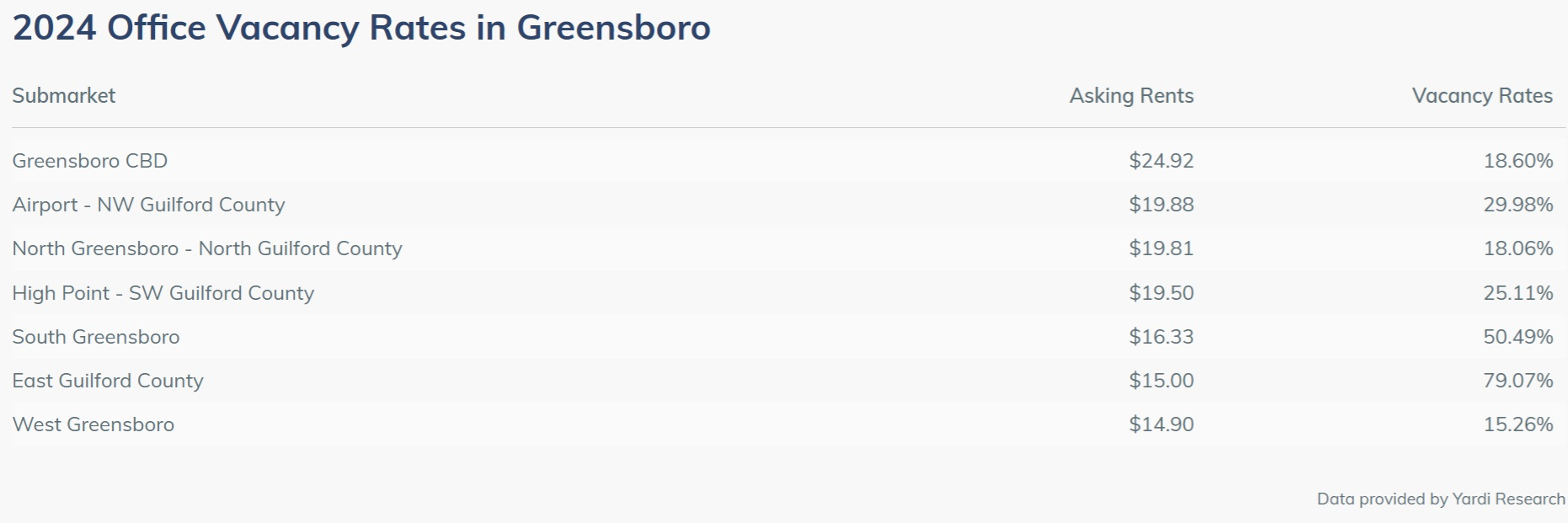
Office; Vitner’s 8.3% vacancy rate assumption is almost certainly Class A / newer inventory only. Market-wide data (CBRE, C&W) show mid-teens to 20%+, which aligns with what anyone walking downtown already knows. Presenting a subset metric as a market metric is misleading even if technically defensible.
From Yardi Research;
Public Integrity Watch isn’t nitpicking. We’re doing the analysis TBJ should have done, or would have if it actually performed investigative journalism.
Industrial; TBJ reports a 4.6% Q4 2025 industrial vacancy rate and uses it to paint a picture of very tight conditions. Realtor CBRE’s Q4 2025 industrial figures for Greensboro/Winston‑Salem show vacancy at 7.7%. If the 4.6% metric refers to a specific subset of properties, the article never explains it. Readers are left believing the Triad is supply-constrained when it’s actually loosening faster than the Triangle.
Apartments; The article reports apartment vacancy rate 9.7% in Q4. Greensboro's apartment vacancy rate was 9.5% in Q4 2025 according to Cushman & Wakefield data, about 2.3 percentage points above the historical national average of 7.3% per the U.S. Census Bureau. Vacancy rates have been rising recently after hitting historic lows around 5.6% in 2021. At 9.5%, Greensboro’s apartment market is approaching the high end of the “healthy” range. While 9.5% isn't crisis-level, it does indicate a softening market that favors renters over landlords, a significant shift from the tight markets of 2021-2022.
From the TBJ article;
Michael Cline, a demographer at N.C. State said... From 2020 to 2024, the Burlington MSA grew by 6.7%, Winston-Salem grew by 4.3% and the Greensboro-High Point area grew by 3.1%. That is compared to Wilmington’s 13% growth, Raleigh-Cary 10.2% growth, the Charlotte area’s 8.1% and the state’s overall 5.7% growth. “We expect growth in this area, and we expect growth in North Carolina, but it’s going to be a slower growth moving forward,” he said.
By failing to contextualize or reconcile the information, TBJ appears to be acting in the best interests of Greensboro’s real estate industry and its advertisers at the expense of average readers.
Context on North Carolina’s Incentives Track Record
TBJ treats incentives as forward-looking guarantees rather than historically unreliable options. That omission biases every conclusion that follows.
In the last five years, North Carolina offered companies $2.7 billion in incentives but only paid out $233 million; of the promised 211,881 jobs, only 99,935 materialized. In 2024, there were 20 failed state incentive projects, and in 2023, 19 projects were unsuccessful.
JetZero
Taxpayers are on the hook for up to $2.35 billion in incentives for JetZero, a company founded 5 years ago which currently employs only 225 people and has never built a full-scale aircraft.
Kevin Baker, executive director of the Piedmont Triad International Airport, said he expects job growth in the region will continue to pick up as employees begin to move to the area for economic development projects such as JetZero’s plan to bring 14,500 jobs to the region by the mid-2030s.
While JetZero’s commitment to the region is significant, the actual timeline for job creation extends far beyond the “mid-2030s” Baker references; the company’s plan envisions adding jobs gradually through 2037, with the full 14,500-job impact not materializing until 2063;
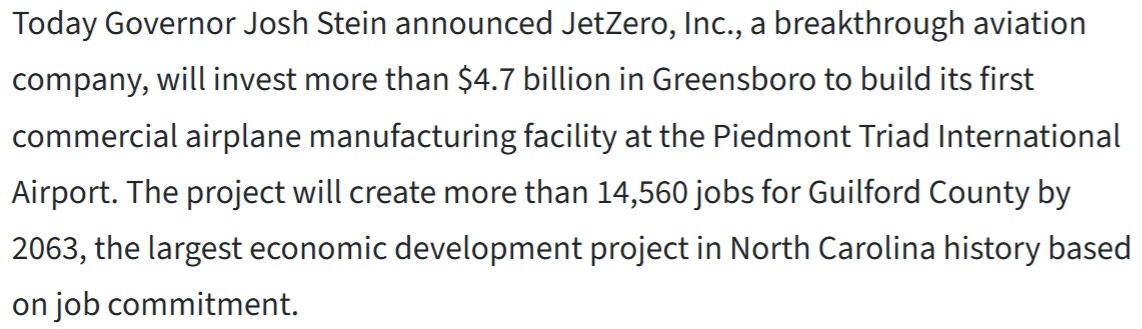
TBJ’s choice of citing Baker’s optimistic projection about JetZero driving near-term job growth in the Triad region without context appears to conflate long-term possibilities with reality.
Baker’s suggestion that employees are already “beginning to move to the area” based on two executive relocations is hardly evidence of meaningful labor migration.
Citing a multi-decade timeline as justification for expecting job growth to “pick up” in the near term demonstrates either a fundamental misunderstanding of economic development timelines or a willingness to spin preliminary corporate commitments into imminent job market transformation, neither of which serves the public’s need for accurate information.
JetZero’s blended wing body aircraft is a highly speculative commercial concept that departs from proven tube-and-wing designs and has never successfully reached commercial passenger service. Flying-wing designs are inherently unstable, requiring complex flight-control systems that remain unproven for civilian transport. Despite billions in research by NASA, Boeing and others, the only operational examples are military aircraft like the B-2 bomber, where cost and commercial viability are irrelevant.
JetZero is effectively asking North Carolina to bet on solving aerospace engineering challenges that have stymied the industry for decades, or to accept that the end product may be military rather than commercial.
The TBJ article makes no mention of Boom Supersonic
Boom Supersonic secured nearly $200 million in government incentives to establish its Greensboro manufacturing hub, where it recently completed its $500 million “Superfactory”. Critics argue the project remains a highly speculative venture that has yet to deliver on its massive economic promises. Although the 150,000-square-foot “Superfactory” is physically complete, it remains largely a “shell” until full-scale Overture production.
Boom is only required to have 561 positions filled by the end of 2026, with the full 1,750+ jobs not due until 2030.
In 2024, Boom faced scrutiny for workforce reductions even as it touted future growth, with the company stating it was “re-prioritizing” its focus toward engine development. Major established engine manufacturers like Rolls-Royce, GE and Pratt & Whitney declined to partner with Boom, forcing the startup to design its own engine, “Symphony,” from scratch; a multi-billion dollar undertaking that even industry giants find risky.
The recent move to sell natural gas turbines for data centers is seen by some as a “quiet retreat” or a desperate attempt to generate cash as the primary goal of supersonic travel faces mounting technical and regulatory hurdles.
TBJ appears to be aligning its framing with the interests of real-estate developers, incentive recipients, and institutional boosters rather than average readers trying to understand actual economic conditions.
The public deserves clear-eyed reporting that distinguishes present conditions from distant possibilities, especially when billions in taxpayer-backed incentives and the region’s economic future are at stake.