
TREBIC’s Jon Hardister Lobbying for Our Taxpayer Money to Subsidize Home Builder Profits
North Carolina’s Housing “Crisis” Isn’t an Excuse to Socialize Developer Risk

Jon Hardister wants you to believe North Carolina’s housing shortage is a shared emergency that demands a “collective effort”; state, local, and private sector all rowing in the same direction;
Housing shortage threatens momentum. Hardister talks development, density and solutions
But once you strip away the rhetoric in the Triad Business Journal’s article by Editor in Chief/Publicist/Propagandist Lloyd Whittington, a clearer picture emerges; Jon is asking taxpayers to underwrite the costs and risks of growth so that developers and large employers, including members of the Triad Real Estate and Building Industry Coalition (TREBIC), which he leads, to protect and expand their profits.
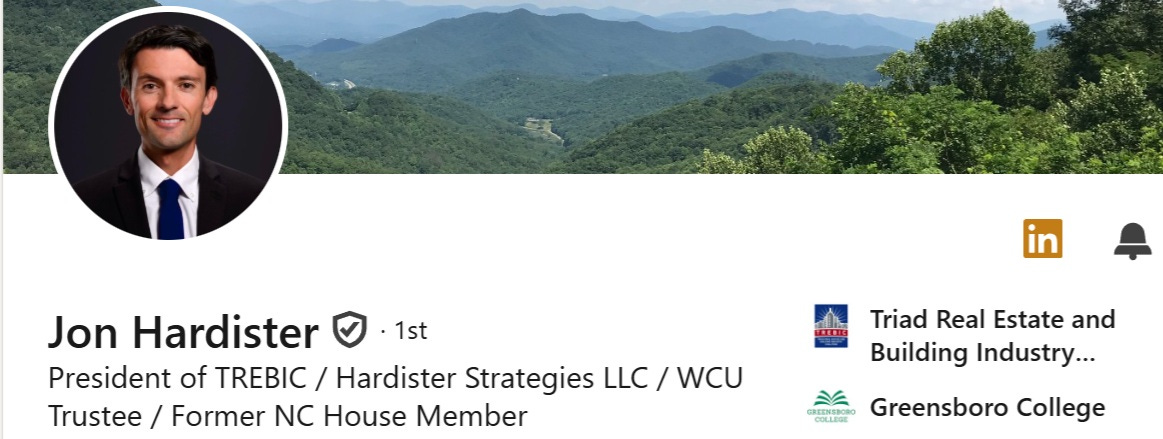
This isn’t “saving the American dream.” It’s shifting the bill to everyone else.
The Hidden Business Model; Public Risk, Private Profit
Hardister and Whittington frame the issue in bleak terms; North Carolina is roughly 800,000 housing units short, with tens of thousands needed in the Triad alone. As big employers like Toyota, Boom Supersonic and JetZero bring jobs, he asks the scary question; where will workers live?
The answer, in their telling, is for taxpayers to bankroll the infrastructure that makes intensive development profitable;
State and local money for roads and transportation.
State local public dollars for water and sewer upgrades.
In other words, the public picks up the tab for the most expensive and least glamorous part of growth, pipes, pavement, permitting systems and higher utility bills, while developers and landowners reap the upside through higher land values, more units to sell and stable or rising prices, which most can’t afford.
Nowhere does Hardister demand proportional givebacks from those who would directly profit; no automatic public equity stake and no enforceable return-on-investment framework for the public taxpayers picking up the tab.
It’s all carrot, no stick.
“Strings Attached”
Hardister;
wants local voters to lose control over how their communities grow when state-level conditions override local planning judgment.
needs local governments to inherit long-term costs; schools, emergency services and ongoing maintenance for the growth they are being pressured into accepting.
while his developer clients gain certainty, speed and new capacity without public benefit, just higher property taxes, water and power bills.
If someone is going to live with the consequences of overburdened schools, clogged roads and stretched utilities, it’s the residents who didn’t ask to be turned into a subsidy base for TREBIC’s members.
Hardister’s “strings” are not about protecting taxpayers; they’re about guaranteeing profit for the industry he represents.
Jon’s use of the crisis is selective.
He points to;
The average first-time homebuyer age creeping up to 40.
A huge share of Gen Z and millennials needing financial help to buy.
It’s real economic pain. But instead of treating it as an indictment of a speculative, profit-driven development model which repeatedly failed to deliver affordability, it’s used as leverage to convince taxpayers to absorb the risk for builders and increase their profits with our taxes.
Notice who is never asked to take a haircut; the developers and investors who’ve enjoyed years of appreciation and profit. Hardister’s conjured “crisis” is a rhetorical weapon to pry open the public wallet for his minions.
Jon’s pitch isn’t a public-interest blueprint; it’s an industry wish list dressed in crisis language to enable direct taxpayer funded financial benefits to TREBIC’s members.
Hardister is not a neutral observer of the housing market. He is;
A former six-term state legislator, deeply familiar with how to shape legislation and appropriations.
The president of a regional real estate and building industry coalition whose members stand to profit from more taxpayer-backed infrastructure.
A public subsidy sponge/lobbyist for his ‘capitalist’ TREBIC members
When someone in that position calls for more taxpayer monies, it’s fair to ask;
Is this about keeping housing affordable for ordinary North Carolinians or ensuring that TREBIC’s members have their risk buffered and profit pipelines secured, as ordinary residents fund the pipes, roads and systems that make those profits possible?
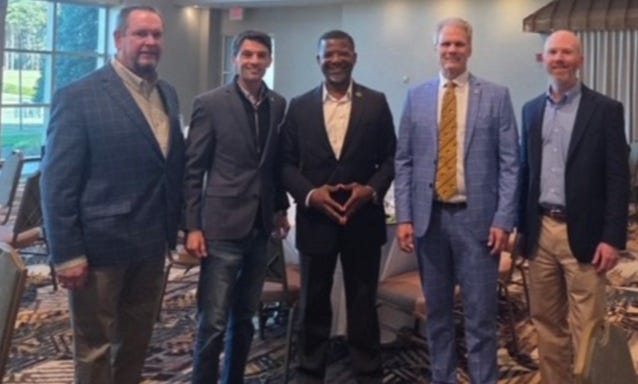
Hardister with councilmember and Greensboro government contractor Hugh Holston, who's supposed to care about rental tenants;

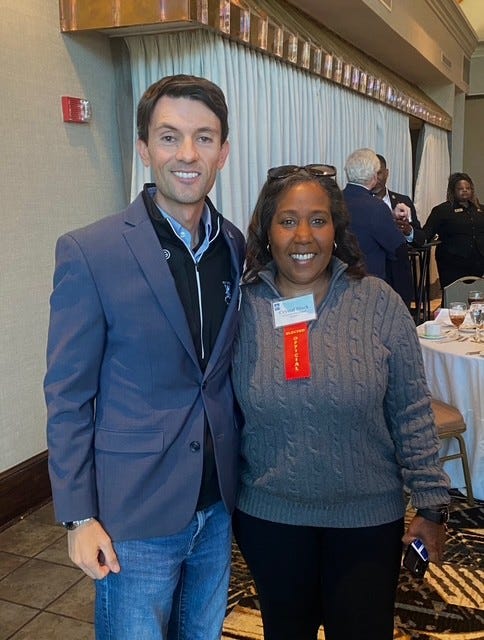
Jon with Greensboro City Councilmember Crystal Black;
Mayor Abuzuaiter, former City Attorney Chuck Watts and City Manager Trey Davis at a TREBIC event;

Adam Marshall, Partner at Law Firm Carolinas, a TREBIC member and new City Council member;
As a registered lobbyist, Jonathan Hardister is registered with these Principals, some of whom are City of Greensboro Contractors;
#1 Amusements, Inc. • Term: 2025
AACRE, LLC • Term: 2025
BusPatrol America • Term: 2025
Greensboro Chamber of Commerce • Term: 2025; Greensboro government contractor
Kick Ass Concepts • Term: 2025; Marty Kotis
National Utility Contractors Association of the Carolinas • Term: 2025
North Carolina Appraisal Institute • Term: 2025; Real Estate
North Carolina Independent Colleges & Universities • Term: 2025
North Carolinians for Texas Hold'em, LLP • Term: 2025
The North Carolina Folk Festival • Term: 2025; Greensboro government contractor
Triad Real Estate & Building Industry Coalition (TREBIC) • Term: 2025
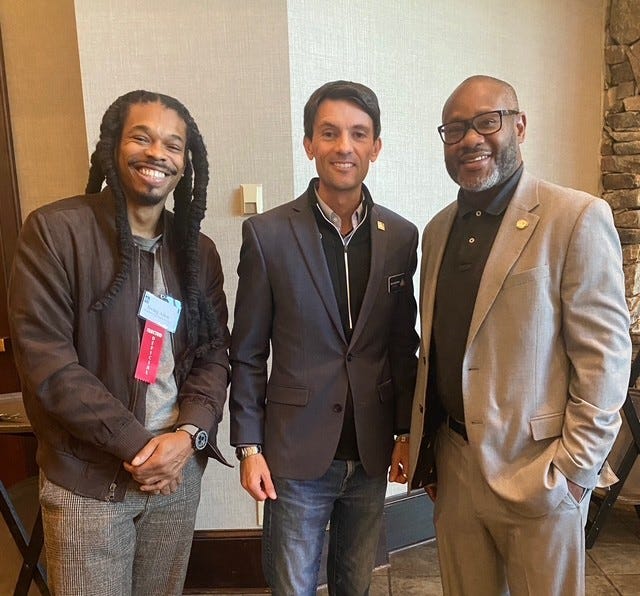
With new Greensboro city councilman Irving Allen;
I call BS.
g
Related;



Disclaimer
This article reflects the author’s analysis, opinions, and conclusions based on publicly available information, reporting, and observed patterns in public policy, lobbying, and local governance. It is intended as commentary on matters of public interest and does not allege criminal conduct unless explicitly stated and supported by verified sources.
All individuals and organizations referenced are mentioned in their public or professional capacities. Any interpretations of motive or impact are presented as opinion, not statements of fact, and readers are encouraged to review the cited sources and form their own conclusions.
This publication is not affiliated with, funded by, or acting on behalf of any political party, developer, industry group, or government entity. Its sole purpose is to examine the use of public resources, transparency in decision-making, and the balance between public risk and private benefit.
This article reflects the personal opinions and interpretations of the author and is offered for informational and commentary purposes only. It is not intended as legal, financial, or professional advice, and readers should not rely on it as such. All references to individuals, organizations, legislation, and events are based on publicly available information to the best of the author’s knowledge at the time of writing; any errors or omissions are unintentional. The views expressed do not represent and should not be attributed to any employer, organization, publication platform, or third party associated with the author. Any mention or characterization of specific people or entities is opinion, not a statement of fact about their motives or conduct. Readers are encouraged to conduct their own research and form their own independent judgments.