
The Unequal Impact of "Revenue-Neutral" Adjustments; For Most of Us, It’s a Tax Hike
When Appreciation Outpaces the Average, So Does Your Tax Bill

Higher Values vs. Lower;
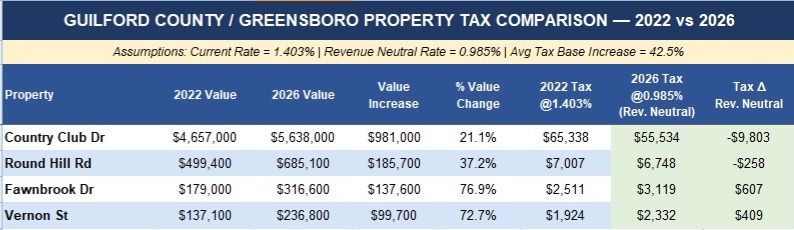
As property values didn’t rise equally, the new rate is a “cut” for those whose more expensive homes appreciated less than average.
For everyone else, tax bills are going up under a revenue neutral revaluation outcome.
At revenue neutral, Fawnbrook and Vernon Street face tax increases of 21-24%, while the higher value Country Club Drive get's a 15% tax cut. The reassessment, in effect, shifts a greater share of Greensboro and Guilford County's tax burden onto those least able to absorb it.
Why? Vertical Inequity; When interest rates went up, affordability drove more buyers to lower and mid-priced homes, inflating values the most. The owners, who haven’t sold or realized a dime of profit, face the steepest tax hikes. Fawnbrook Drive appreciated 76.9%, far exceeding the implied average of roughly 42.5%. As lower valued home values grew much faster as interest rates rose, its share of the tax base increased significantly, leading to a massive tax increase for a homeowner most likely not able to absorb the spike.
The burden is being shifted from the wealthy to those of more moderate means. Country Club Drive’s home (Louis DeJoy & Aldona Wos) only went up 21.1% compared to approximate 42.5% average. High-value homes which appreciated less than average, (like the Greensboro Sports Foundation CEO Richard Beard’s Round Hill Rd home), should see tax reductions if both Greensboro and Guilford County keep incoming taxes at the same amount as last year under the anticipated revenue neutral rate numbers.
Taxing the Unrealized Wealth of the Middle and Lower Classes; Homeowners with sharp paper gains will be forced to pay more. The bill increases without regard for income, placing a heavy burden on families who are suddenly “house rich but cash poor”, ignoring the ability for lower income residents and seniors to absorb the increased taxes to offset the wealth tax breaks.
It’s a reverse Robin Hood; The bottom and middle are going to subsidize the top. Higher-valued homes with modest appreciation will see their taxes fall or stay flat while working-class neighborhoods foot the bill, along with increased homeowners insurance premiums and escrow payments, compounding the financial pressure.
About 50% of households in Greensboro are rentals. When landlords get hit, they pass the cost to tenants. If the Farmbrook home is a rental, the landlord’s tax bill goes up $607, and raises rent by at least $50+/month to cover the cost. Even if a rental property is wildly over-assessed, many landlords won’t appeal if there’s too much to fix, so higher costs for substandard properties are passed on to many unlikely to be able to afford the increases.
Revaluation Driven Tax Increases Function as a Tax on Unrealized Gains
Revenue-neutral or not, when revaluations produce large spikes for certain homeowners, the practical effect is the same; government is taxing equity that exists only on paper. Our elected leaders should at least explain why a retired homeowner on Social Security should owe more.
Stealth Tax Increases
In 2022, after property values in Guilford County increased by roughly 25-30% during revaluation, Guilford County’s Commissioners chose not to lower the property tax rate to a revenue-neutral level. By keeping the same rate, the county generated approximately $92 million in additional annual revenue compared to what a neutral adjustment would have produced. Greensboro adjusted its rate higher than neutral as well, and many property owners saw tax bills increase by around 30% in 2022-23, purposefully obscured by the mechanics of revaluation.
A 10% rate hike wouldn’t just add a little to everyone’s bill; it compounds the pain for those already getting hit hardest. Dejoy’s increase would still be a $4,251 tax cut. Richard Beard’s goes from -$258 to +$416. But the Fawnbrook Drive home, already facing a $607 increase under revenue neutral, gets pushed to the brink at $920 more per year, an extra $77/month increase for a homeowner or a renter with lower income. That’s not shared sacrifice, it shifts the heaviest burden onto those least able to afford it.
Let’s not let it happen again