
Is the City of Greensboro, North Carolina Violating the Civil Rights of Minority Tenants?
The Unintended (or Intended?) Consequences of Dismantling Greensboro's Minimum Housing Commission

The District at Market Street apartments evacuation wasn’t an accident. It was the result of a years-long campaign to dismantle tenant protections. The result is a gutted oversight system, leading to hundreds of unresolved complaints, overwhelmingly in low income minority occupied areas of town.
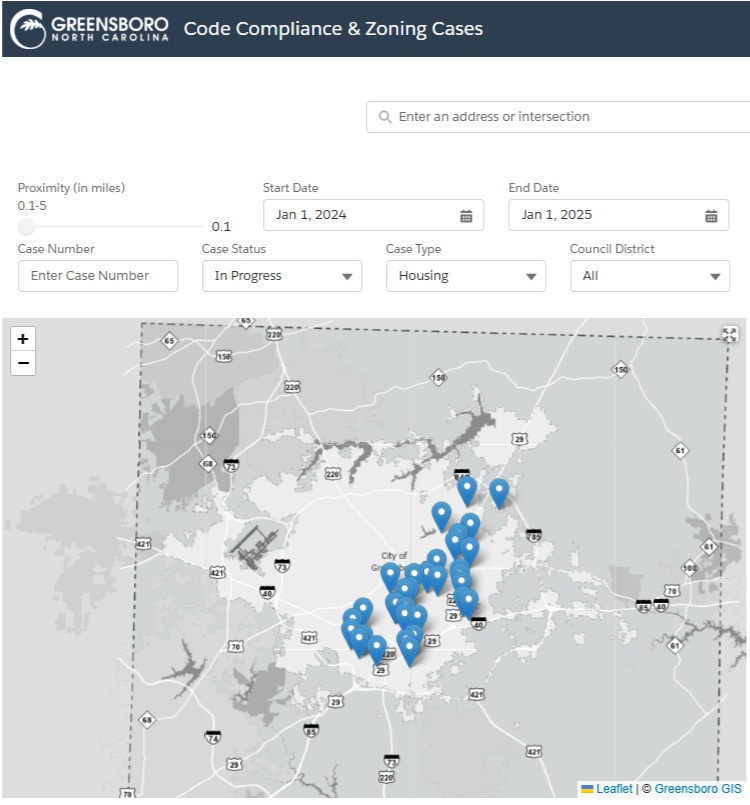
Greensboro, North Carolina 01/01/2024 to 01/01/25 Open Code Violations to Racial Map;
Based on the city’s own stated timeline and procedures, the vast majority of housing code violation cases initiated between January 1, 2024, and January 1, 2025 which are still open and should have been resolved by now, is a major red flag indicating systemic breakdown;
The City’s “Inspection Process”, which is supposed to bring violations to the Minimum Housing Standards Commission (MHSC), but didn’t;
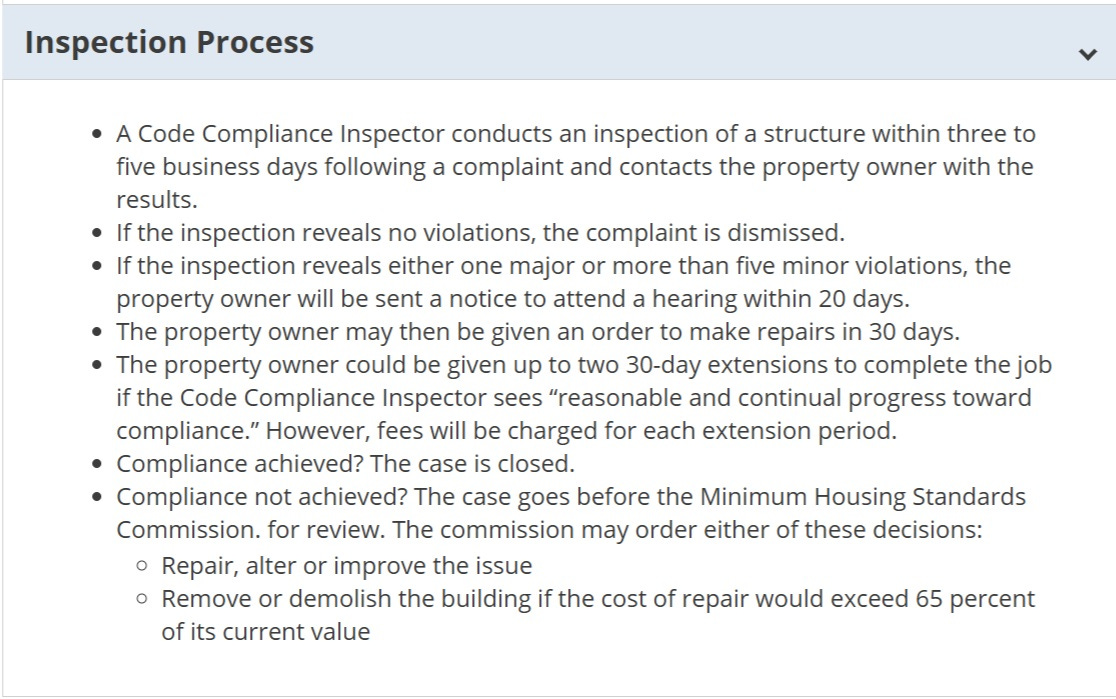
Even with the maximum extensions, the process from complaint to a final MHSC order should take roughly 115+ business days (about 5.5 calendar months). A case filed on January 1, 2024, should have reached its final procedural step (an MHSC order) by mid-summer 2024 at the absolute latest.
The procedural timeline shows “In Progress” cases from 2024 are stuck in a failed process. There are only a few possible explanations;
If a case requires MHSC review (because the owner failed to comply) and the commission has been stripped of its ability to act publicly or efficiently, then cases simply pile up in a queue with no resolution.
Inspectors may be granting endless 30-day extensions based on minimal progress, letting negligent owners drag out cases without meaningful repair.
The step of sending a case to the MHSC for non-compliance has only been happening for owner occupied, single family homes set for demolition, not multifamily rental properties. The city’s policy of “withholding violations from the MHSC” means cases that should have been escalated were instead left in administrative limbo.
When mapped, these unresolved cases show a clear disparate racial impact, transforming the City’s failures into potent Fair Housing Act violations based on the predictable and disproportionate harm to minority residents;
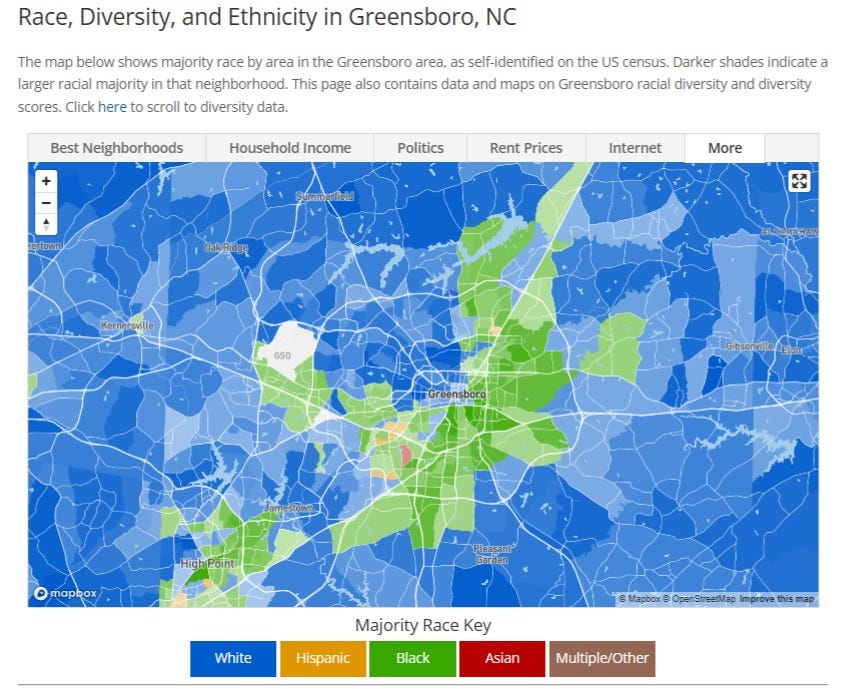
Geographic Overlay; As Greensboro’s low income multifamily housing stock is concentrated in the minority majority neighborhoods, the burden (misrepresenting the law and withholding violations from the commission) fell predictably and disproportionately on protected classes. The “open code violations” from 01/01/2024-01/01/2025 clusters in these areas without resolution.
Spatial Concentration; The racial map shows clear geographic segregation, with neighborhoods having distinct racial majorities (Black, Hispanic, White).
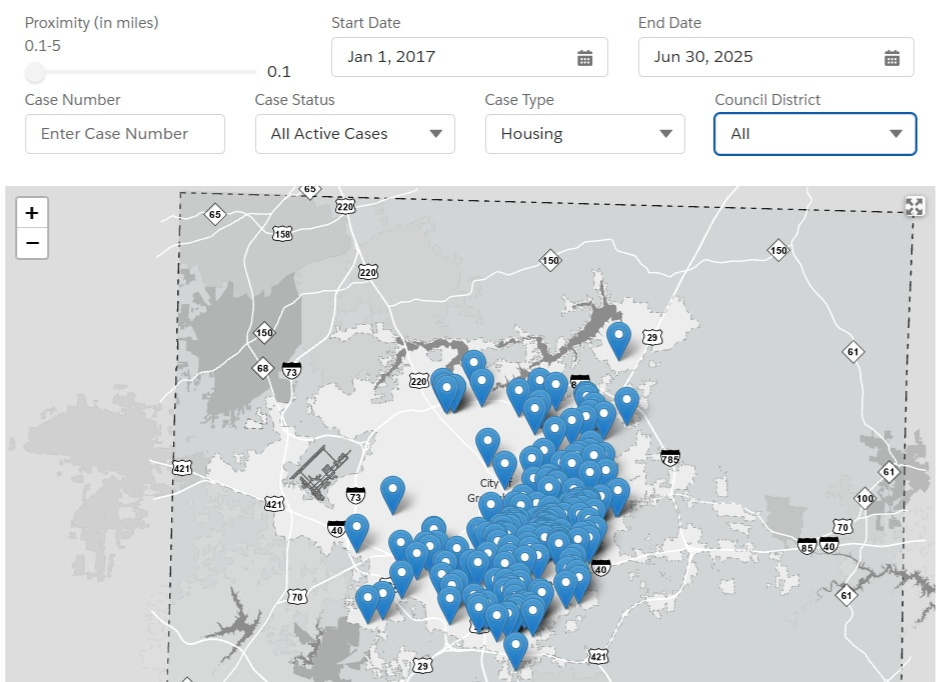
All active housing cases up until June 30, 2025, 122 business days ago as of 12/30/2025, overwhelmingly most of which should have been resolved by now;
Legal Framework;
A. Disparate Impact (Fair Housing Act); This is the strongest legal avenue. The policy of defanging the MHSC is “facially neutral” (applies to all multifamily housing) but has a demonstrably discriminatory effect. The city would then bear the burden to prove a substantial, legitimate, nondiscriminatory interest for the policy changes.
Collapsing Justification; If the primary justification was the city attorney’s office misrepresentations of state law, the city’s “legitimate interest” defense is severely undermined, if not invalidated.
Less Discriminatory Alternative; The complainants can argue that maintaining a functional, independent MHSC was a readily available, less discriminatory alternative.
B. 42 U.S.C. § 1983 (Civil Rights Deprivation); The alleged intentional misconduct by city officials adds a layer of potential liability. If officials acted under color of law to deprive residents of their right to safe housing and right to petition their government for redress (via a public commission), and this deprivation tracks racial lines, a § 1983 claim is viable.
C. Affirmatively Furthering Fair Housing (AFFH); Federal funding recipients like the City of Greensboro, have an obligation to proactively overcome patterns of segregation and promote fair housing. Systematically withdrawing enforcement mechanisms from minority neighborhoods is a prima facie failure of this duty.
The Significance of the MHSC’s Dismantling;
The legal argument centers on functional consequence. If the MHSC was the primary effective channel for addressing serious code violations in multifamily housing and its powers were removed, the city functionally created a policy of non-enforcement in the neighborhoods most dependent on that mechanism.
The October 16, 2024, MHSC meeting transcript reveals frustrated tenants being silenced by procedural rules as they attempted to describe severe, ongoing housing violations. It doesn’t just illustrate the systemic failure; it provides direct evidence of the bad-faith application of rules to silence tenants. The transcript provides direct evidence for a Section 1983 claim, demonstrating that city officials, acting under color of law, weaponized a procedural rule to deprive tenants of their First Amendment right to petition the government for redress of grievances.
That there was only one item handled by the commission at the same meeting reveals a housing enforcement system strategically reduced to a ceremonial role, processing only the most extreme and legally unambiguous cases while actively blocking the pathway to remedy for thousands of tenants living in substandard conditions.
https://www.greensboro-nc.gov/home/showpublisheddocument/61180/638690855618930000
The next two MHSC meetings were cancelled;
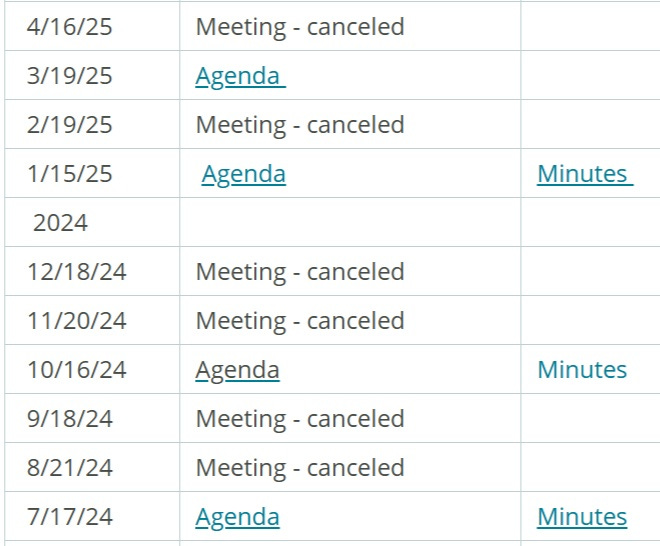
After dealing with another one item agenda on January 15, 2025, City attorney Tony Baker admitted, on the record, that the City was knowingly leaving tenants in dangerous units because fixing the problems were too hard and would expose a deeper affordable housing catastrophe.
Greensboro’s housing enforcement has not merely broken down; it was consciously deactivated. The city made a calculated decision to manage the symptoms of its housing failures by sacrificing the health, safety and civil rights of its most vulnerable renters. This is a textbook case for intervention by the U.S. Department of Justice, as it involves a municipal government’s systemic abdication of its duty to protect citizens, justified by an admission of discriminatory effect.
Despite a formal request by the Commission during the meeting for a full work session with all members of City Council, no such session occurred.
https://www.greensboro-nc.gov/home/showpublisheddocument/61760/638743679240300000
The 2/19/25 meeting was cancelled. The 3/19/25 meeting had an agenda with one item but no minutes. The 4/16/25 meeting was cancelled. A special meeting on graffiti on a downtown building took place on 4/23. The 5/21/25 meeting was cancelled.
On June 18, 2025, the transcript shows members of the Commission escalating accusations of bureaucratic failure to alleged active suppression, detailing organized external interference and direct obstruction. Commissioner Samuel Hawkins explicitly referenced an “apartment/landlord cartel” operating within the city, suggesting potential collusion between private interests and public systems serving a profit driven agenda. Hawkins revealed a plan to address the issue during a City Council public comment period but was derailed after “statements... from a third party” were made to City Council. The formal request for a meeting with the City Council received no response.
Every avenue for redress; tenant testimony before the commission, the commission’s own actions and direct appeals to elected officials was rendered futile. This reveals more than passive neglect, but a calculated effort to shield inaction from accountability.
https://www.greensboro-nc.gov/home/showpublisheddocument/63236/638874923073570000
The 7/16/25 and 8/20/25 MHSC meetings were cancelled.
The 9/17/25 meeting attended by City Attorney Lora Cubbage, an anomaly, had no cases for the commission to judge. Operations Manager Jeffrey Kivette explicitly stated “for the last several years, staff was instructed that the Commission would only hear the worst of the worst cases. If it is not ready to be knocked down, don’t bring it before the Commission”, confirming the commission’s purpose was functionally eliminated in its role in enforcing repairs and habitability standards for the vast majority of violations, explaining the empty dockets and cancelled meetings.
City Attorney Cubbage interpreted the Commission’s empty docket as a potential “good sign,” overlooking the deliberate systemic filtering of cases. She repeatedly redirected commissioners to engage individually with their council members, a tactic fragmenting collective advocacy and reinforcing the strategy of isolation. Cubbage offered to facilitate a meeting with fewer than five council members in closed sessions to avoid public meeting requirements, rather than through a transparent, accountable process open to the public.
The City Attorney’s office functioned not as independent legal counsel for the Commission, but as an active instrument of control and intimidation to enforce a political agenda, through which landlords increased profits at the expense of their tenants.
MHSC Chair Franklin Scott’s testimony revealed a pattern of direct threats and calculated restructuring aimed at neutralizing the commission. During a training session, the previous City Attorney, Chuck Watts, explicitly threatened commissioners, stating he “was going to recommend to Council to replace...” any member who acted outside the city’s directives.
Certain commissioners were indeed replaced. Beyond personnel changes, the City Attorney’s office engaged in constant procedural overreach. Scott described ongoing battles where Deputy City Attorney Tony Baker and others attempted to directly run the meetings, transforming the attorney’s role from legal advisement into operational control.
Collectively, these actions paint the City Attorney’s office as the enforcement arm of a deliberate campaign to subdue the commission. Its role shifted from providing legal guidance to ensuring compliance through threats, purges and administrative domination.
https://www.greensboro-nc.gov/home/showpublisheddocument/64339/638950118800130000
In October 2025, the Howard Johnson motel on North O.Henry Boulevard in Greensboro was ordered shut down by a judge, culminating years of documented crises ranging from fatal overdoses to violent crime. While the closure addressed an urgent public safety threat, the case completely bypassed the commission designated to handle dangerous housing violations.
Instead of utilizing the MHSC, the City Attorney’s Office filed a civil nuisance abatement lawsuit. This approach proved effective for achieving immediate closure, but it left the Commission in the dark. Despite residents bringing well-documented life-safety violations, from faulty electrical wiring to inoperative smoke detectors to the City, the MHSC had no authority to intervene as the cases were never referred to the Commission by the city’s housing code enforcement apparatus.
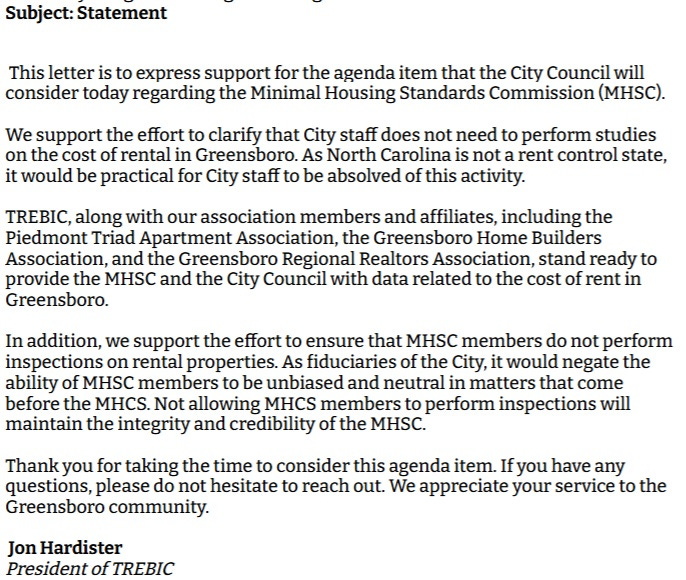
On 11/18/25, the last City Council meeting before six new members were sworn in, at the request of Triad Real Estate and Building Industry Coalition (TREBIC) President Jon Hardister and advocated by City Manager Trey Davis and the City Attorney’s office under Lora Cubbage, the Council passed an ordinance stripping the MHSC of core powers;
As of December 9, 2025, the city had 381 active housing cases, yet 5 out of the 12 scheduled MHSC meetings were canceled, per an email from Senior Code Compliance Manager Christie Holt to then MHSC Chair Franklin Scott. 69 of the 381 cases were identified as multi-family complexes.
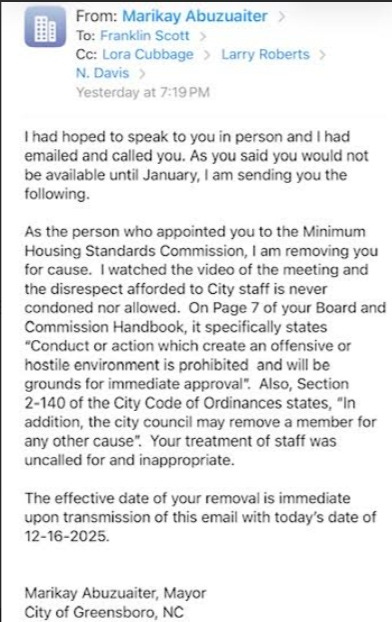
On December 16, newly sworn in Mayor Marikay Abuzuaiter unexpectedly removed MHSC Chair Franklin Scott at the end of the meeting with a voice vote. Abuzuaiter sent Scott an email beforehand, Cc’d are Lora Cubbage, City Manager Trey Davis and Chief of Code Compliance Larry Roberts;
The District at West Market apartments were evacuated on the same day.
The next day, at December 17’s MHSC meeting, former Chairman Franklin Scott spoke from the floor as a citizen, and said “It is unfortunate that some have possibly forgotten that they work for the people,” Scott continued. “City staff works for the Commission, the residents of Greensboro; the members do not work for the City. The elected officials are in their roles because they work for the residents of the City.” He recalled the Commission was told by Attorney Cubbage at the September meeting that, “If you can’t do it, just resign.”
Scott recalled during training, when the commission presented a proposal to be taken to Council, they were told via a directive from the City Attorney’s Office and from the Chief of Compliance, that they could not.
The dismantling of the MHSC was not a bureaucratic reorganization, but a political strategy with a predictable and severe outcome. By strategically filtering cases, silencing tenant testimony, threatening commissioners and ultimately stripping the commission of its power at the urging of landlord advocacy groups, the city engineered a systemic withdrawal of housing protections.
The burden of this deactivated enforcement apparatus fell overwhelmingly on minority neighborhoods, where the majority of the city’s low income multifamily rental stock is concentrated.
The commissioners threatened for advocating too forcefully were themselves predominantly minority appointees.
The claim of legal necessity was based on a misrepresentation of state law. The claim that enforcement would cause homelessness is an admission of a self-created crisis, not a legitimate defense.
A single thread connects all; a conscious decision to insulate negligent property owners and a failing housing policy from challenge, regardless of the human cost. The price has been disproportionately paid by minority residents, living for months or years in conditions the city officially condemns but refuses to effectively remedy.
The pattern warrants immediate investigation by the U.S. Department of Justice and the Department of Housing and Urban Development. The facts demonstrate a prima facie case of disparate impact under the Fair Housing Act, potential deprivation of rights under Section 1983, and a wholesale failure to affirmatively further fair housing. Greensboro’s housing enforcement was not broken. It was deliberately and knowingly dismantled, and the consequences have been borne along stark racial lines.
Related;


Disclaimer: This article is an analytical synthesis based on publicly available documents and interviews with previous commissioners, including City of Greensboro Minimum Housing Standards Commission meeting transcripts (2024-2025), City Council ordinances, public statements, and procedural timelines. The allegations contained herein, including those regarding the intent, impact, and potential legality of city policies and officials’ actions, are presented as an analysis of this documentary record and have not been adjudicated by a court of law.
The references to potential violations of the Fair Housing Act, 42 U.S.C. § 1983, and other civil rights statutes are legal analyses of the fact pattern presented by the public record, not definitive findings of liability. Any individuals or entities named are identified in their official capacities based on their roles as reflected in public documents.
This article does not constitute legal advice. Readers, including tenants, officials, or advocates, should seek professional legal counsel for matters concerning specific rights or claims.
The conclusions drawn represent an interpretation of the documented sequence of events and their disproportionate geographic and demographic impact. The City of Greensboro and any named parties retain the right to present their own evidence and legal justifications in any appropriate forum. This analysis is published in the public interest to inform civic discourse and accountability.